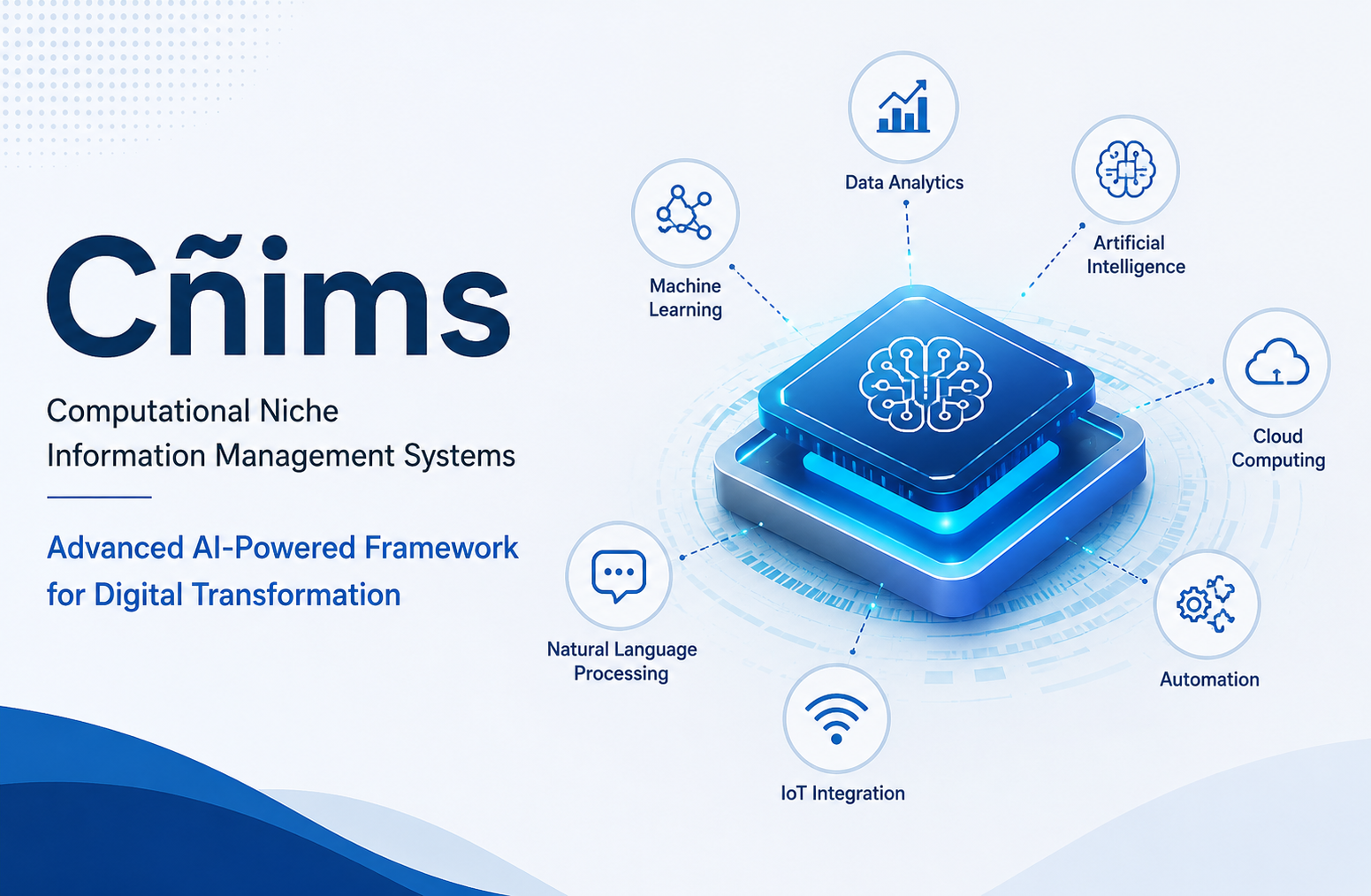
Cñims: AI Framework for Digital Transformation
Cñims is emerging as a modern approach to intelligent digital transformation by combining artificial intelligence, automation, machine learning, and advanced data analytics into a unified framework. As organizations generate larger volumes of data and face increasingly complex operational challenges, traditional management systems often struggle to deliver the speed, accuracy, and flexibility required in today’s competitive environment. This is where Cñims offers a more intelligent way of managing information, workflows, and decision making through automated and data driven processes.
Businesses across industries are investing heavily in digital technologies to improve efficiency, reduce operational costs, and make smarter decisions. However, implementing multiple technologies separately can create disconnected systems, inconsistent data, and inefficient workflows. A unified framework that brings these technologies together provides a significant advantage by enabling organizations to operate more efficiently while adapting to changing business requirements.
The concept behind Computational Niche Information Management Systems focuses on integrating artificial intelligence with advanced information management capabilities. Rather than acting as a single software application, it serves as a comprehensive framework capable of coordinating data collection, processing, predictive analysis, workflow automation, and intelligent recommendations across multiple business environments.
As artificial intelligence continues evolving, organizations increasingly require systems that not only process information but also understand patterns, identify opportunities, predict future outcomes, and recommend actions with minimal human intervention. This intelligent approach allows companies to shift from reactive decision making toward proactive business management.
This guide explains everything you need to know about Cñims, including its architecture, working principles, major technologies, business applications, implementation strategies, advantages, limitations, future developments, and practical considerations for organizations planning digital transformation initiatives.
What Is Cñims?
Cñims stands for Computational Niche Information Management Systems. It is an AI powered framework designed to manage complex digital operations through intelligent automation, advanced analytics, machine learning models, natural language processing, and cloud based computing technologies.
Unlike traditional information management systems that primarily store and organize data, this framework actively analyzes incoming information, recognizes patterns, generates predictions, automates repetitive tasks, and supports strategic decision making across multiple departments.
Its primary objective is improving organizational performance by reducing manual workloads while increasing the speed and quality of operational decisions.
The framework combines several advanced technologies into one intelligent ecosystem where each component continuously exchanges information with the others.
Some of its core capabilities include:
- Intelligent workflow automation
- Predictive analytics
- Real time monitoring
- Autonomous decision support
- Data integration
- Resource optimization
- Process intelligence
- Business forecasting
- Information governance
- Operational scalability
Instead of functioning as isolated software modules, these capabilities work together to improve organizational efficiency.
Why Modern Businesses Need Intelligent Information Management
Digital transformation has changed how organizations collect, process, and utilize information. Companies now manage enormous amounts of structured and unstructured data originating from customers, suppliers, connected devices, cloud services, financial platforms, and operational systems.
Without intelligent management, businesses commonly experience:
- Data silos
- Duplicate information
- Slow reporting
- Delayed decision making
- Human errors
- Inefficient workflows
- Poor customer experiences
- High operational costs
Traditional enterprise systems often require employees to manually analyze reports before making business decisions. This process consumes valuable time and increases the possibility of errors.
Artificial intelligence changes this model by automatically analyzing data in real time, identifying patterns that humans may overlook, and generating actionable insights almost instantly.
This shift enables organizations to become significantly more responsive to changing market conditions.
Core Objectives of Cñims
The framework is designed around several important objectives that support modern digital enterprises.
Intelligent Automation
One of its primary goals is reducing repetitive manual work through automated workflows.
Instead of requiring employees to perform routine tasks repeatedly, automation handles activities such as:
- Document processing
- Data validation
- Workflow routing
- Report generation
- Customer request classification
- Notification management
Employees can therefore spend more time on strategic activities requiring creativity and human judgment.
Better Decision Making
Organizations generate vast amounts of operational information every day.
Artificial intelligence analyzes this information continuously to identify:
- Emerging trends
- Performance issues
- Business opportunities
- Operational risks
- Customer behavior
- Resource utilization
Decision makers receive recommendations supported by data rather than relying solely on assumptions.
Improved Operational Efficiency
Automation reduces unnecessary delays across departments.
Processes that previously required several hours may now complete within minutes.
Examples include:
- Purchase approvals
- Inventory updates
- Customer support routing
- Financial reconciliation
- Production scheduling
This improved efficiency directly contributes to higher productivity.
Scalability
Growing organizations often struggle with increasing operational complexity.
An intelligent framework supports expansion without requiring proportional increases in administrative effort.
Additional users, departments, data sources, and operational processes can often be integrated more efficiently than with conventional management systems.
Key Technologies Behind Cñims
Several advanced technologies work together to create an intelligent operational environment.
Artificial Intelligence
Artificial intelligence forms the central intelligence layer.
Its responsibilities include:
- Pattern recognition
- Decision support
- Learning from historical information
- Process optimization
- Intelligent recommendations
- Automated reasoning
AI continuously improves system performance as additional data becomes available.
Machine Learning
Machine learning allows models to improve accuracy through experience.
Instead of following fixed programming rules, machine learning algorithms identify relationships within historical datasets.
Applications include:
- Demand forecasting
- Customer segmentation
- Fraud detection
- Equipment maintenance prediction
- Recommendation engines
The more quality data available, the more accurate predictions generally become.
Advanced Data Analytics
Organizations collect information from many sources.
Analytics transforms raw information into meaningful insights.
This includes:
- Trend analysis
- Performance measurement
- Operational forecasting
- Customer analytics
- Financial analysis
- Resource planning
Decision makers gain a clearer understanding of business performance.
Natural Language Processing
Natural Language Processing enables computers to understand human language.
Typical applications include:
- Intelligent chat systems
- Email analysis
- Document classification
- Voice assistants
- Automated customer service
- Knowledge extraction
This significantly improves communication between users and digital systems.
Cloud Computing
Cloud infrastructure provides flexibility and scalability.
Organizations benefit from:
- Remote accessibility
- Elastic computing resources
- Centralized storage
- Disaster recovery
- Simplified collaboration
Cloud environments also support integration with many external business platforms.
Internet of Things
Connected devices generate continuous operational data.
Examples include:
- Manufacturing sensors
- Smart vehicles
- Medical devices
- Environmental monitoring
- Supply chain tracking
Real time sensor information enhances predictive analysis and operational awareness.
How Cñims Works
Although implementation varies between organizations, the framework generally follows several stages.
Step 1. Data Collection
Information enters the platform from multiple internal and external sources.
Examples include:
- ERP systems
- CRM platforms
- Cloud databases
- Mobile applications
- IoT sensors
- Customer portals
- Financial software
- Operational equipment
Data quality controls ensure information remains consistent.
Step 2. Data Processing
Incoming information is cleaned, standardized, categorized, and organized.
Duplicate records are identified while missing information may be flagged for review.
This preparation improves analytical accuracy.
Step 3. Artificial Intelligence Analysis
Machine learning models analyze processed information.
The system identifies:
- Hidden patterns
- Behavioral trends
- Operational bottlenecks
- Business risks
- Future forecasts
These insights support informed decision making.
Step 4. Intelligent Decision Support
Based on analytical findings, the framework generates recommendations.
Decision makers may receive suggestions such as:
- Adjust inventory levels
- Reallocate resources
- Schedule maintenance
- Detect unusual financial activity
- Optimize staffing
- Improve customer engagement
Recommendations continue improving as the system learns from outcomes.
Step 5. Continuous Learning
One of the strongest characteristics of intelligent frameworks is continuous improvement.
Every completed process provides additional learning opportunities.
Machine learning models update themselves using historical outcomes, increasing prediction accuracy over time.
Benefits of Adopting Cñims
Organizations implementing intelligent information management often experience improvements across multiple operational areas.
Higher Productivity
Automation eliminates repetitive administrative work, allowing employees to focus on higher value activities such as innovation, customer relationships, and strategic planning.
Faster Decision Making
Instead of waiting for manually prepared reports, managers receive near real time insights supported by advanced analytics.
Better Accuracy
Automated validation and AI driven analysis reduce common human errors associated with manual data processing.
Cost Optimization
Improved resource utilization, automated workflows, and predictive maintenance help organizations lower operational expenses while maximizing efficiency.
Industry Applications of Cñims
One of the biggest strengths of Cñims is its flexibility. Instead of being limited to a single sector, the framework can support organizations across industries by combining intelligent automation with data driven decision making. While every organization has unique requirements, the underlying principles remain consistent: collect quality data, analyze it intelligently, automate repetitive work, and provide actionable insights.
Below are some of the most common real world applications.
Manufacturing
Manufacturers operate in environments where downtime, production delays, and quality issues can significantly affect profitability. Intelligent management systems help reduce these risks by continuously monitoring operations.
Common applications include:
- Predictive maintenance for industrial equipment
- Production scheduling optimization
- Automated quality inspections
- Inventory monitoring
- Supplier performance analysis
- Energy consumption optimization
Instead of waiting for equipment to fail, AI models analyze sensor data and identify warning signs before breakdowns occur. This approach minimizes unexpected downtime while extending equipment life.
Manufacturers also benefit from automated production planning, allowing facilities to adjust schedules according to changing demand without relying entirely on manual planning.
Healthcare
Healthcare organizations generate enormous amounts of information every day. Managing patient records, medical devices, appointments, treatment plans, laboratory results, and operational resources requires both accuracy and speed.
An intelligent framework can support healthcare by improving information flow across departments.
Potential applications include:
- Patient monitoring
- Clinical decision support
- Medical image analysis
- Appointment scheduling
- Hospital resource planning
- Electronic health record management
Healthcare professionals remain responsible for final clinical decisions, while AI provides analytical support that helps identify trends and prioritize important information.
This collaboration allows medical staff to spend more time focusing on patient care instead of administrative tasks.
Financial Services
Financial institutions process millions of transactions every day. Detecting fraud, managing investment portfolios, assessing credit risk, and complying with regulations require continuous analysis.
AI powered information management supports financial organizations through:
- Fraud detection
- Risk analysis
- Credit assessment
- Portfolio optimization
- Customer segmentation
- Regulatory reporting
Machine learning algorithms can recognize unusual transaction patterns much faster than manual reviews, helping financial organizations respond quickly to suspicious activities.
Predictive analytics also assists institutions in identifying potential risks before they become significant financial problems.
Retail
Retail businesses constantly balance inventory, pricing, customer preferences, logistics, and marketing campaigns.
Modern retailers rely on data from multiple channels including websites, mobile applications, physical stores, and customer loyalty programs.
An intelligent framework supports:
- Demand forecasting
- Inventory optimization
- Personalized product recommendations
- Customer behavior analysis
- Supply chain management
- Dynamic pricing strategies
Better forecasting reduces stock shortages while preventing unnecessary inventory accumulation.
Personalized recommendations also improve customer satisfaction by presenting products aligned with purchasing behavior.
Transportation and Logistics
Transportation companies operate in highly dynamic environments influenced by weather, traffic, fuel costs, customer demand, and delivery schedules.
Intelligent management systems improve operational visibility through:
- Fleet management
- Route optimization
- Vehicle maintenance prediction
- Cargo tracking
- Delivery scheduling
- Fuel efficiency analysis
Organizations gain greater control over logistics while improving delivery reliability and reducing operational expenses.
Smart Cities
Cities increasingly depend on connected technologies to improve public services.
Information management frameworks support urban development through:
- Traffic monitoring
- Public transportation optimization
- Environmental monitoring
- Emergency response coordination
- Energy management
- Infrastructure maintenance
By combining sensor data with AI driven analysis, city administrators can make more informed planning decisions that improve public services.
Business Benefits
Organizations investing in intelligent operational frameworks often experience improvements that extend beyond simple automation.
Improved Efficiency
Routine activities consume valuable employee time.
Automation streamlines repetitive processes while reducing unnecessary manual intervention.
Examples include:
- Invoice processing
- Customer request routing
- Employee onboarding
- Procurement approvals
- Data synchronization
Employees become more productive because repetitive administrative work decreases.
Better Resource Allocation
Artificial intelligence identifies where organizational resources produce the greatest value.
This helps organizations optimize:
- Staffing
- Budget allocation
- Equipment utilization
- Production capacity
- Inventory distribution
Smarter allocation contributes to improved operational performance.
Faster Response Times
Real time analytics enables organizations to react quickly to changing circumstances.
Instead of waiting for scheduled reports, managers receive updated information whenever important changes occur.
Examples include:
- Inventory shortages
- Equipment failures
- Customer complaints
- Security incidents
- Financial anomalies
Earlier responses often reduce operational disruption.
Improved Customer Experience
Customers expect faster service, personalized interactions, and consistent communication.
AI supports these expectations by improving:
- Customer support
- Personalized recommendations
- Order processing
- Response accuracy
- Service availability
Higher customer satisfaction frequently contributes to improved retention.
Better Strategic Planning
Executive teams require reliable information for long term planning.
Predictive analytics provides valuable forecasts related to:
- Market demand
- Financial performance
- Operational capacity
- Customer growth
- Supply chain risks
These insights support better strategic decisions while reducing uncertainty.
Key Components of an Intelligent Framework
Although implementations vary, most intelligent information management systems include several essential components.
Data Integration Layer
Organizations often operate multiple software systems simultaneously.
The integration layer connects information from:
- ERP platforms
- CRM software
- Cloud applications
- Databases
- IoT devices
- Third party services
This centralized approach eliminates many data silos.
Analytics Engine
The analytics engine processes collected information.
Responsibilities include:
- Statistical analysis
- Trend identification
- Forecast generation
- Performance measurement
- Pattern recognition
Decision makers receive meaningful insights instead of raw data.
Automation Engine
Automation coordinates workflows across departments.
Typical automated activities include:
- Notifications
- Approval routing
- Report generation
- Data synchronization
- Task scheduling
Automation reduces delays while improving consistency.
Artificial Intelligence Layer
The AI layer continuously evaluates operational information.
Its functions include:
- Recommendation generation
- Predictive analysis
- Intelligent classification
- Decision support
- Adaptive learning
Unlike static software, AI improves as additional information becomes available.
Security Framework
Information security remains a critical requirement.
Organizations typically implement:
- Identity management
- Access control
- Encryption
- Activity monitoring
- Threat detection
- Audit logging
Strong security protects sensitive business information while supporting regulatory compliance.
Challenges Organizations Should Expect
Despite its advantages, implementing advanced digital frameworks requires careful planning.
Legacy System Integration
Many organizations continue using software developed years ago.
Older systems may not easily communicate with modern AI platforms.
Integration projects often require additional development, testing, and process redesign.
Data Quality Problems
Artificial intelligence depends on reliable information.
Poor quality data may include:
- Missing values
- Duplicate records
- Incorrect classifications
- Outdated information
- Inconsistent formats
Organizations should improve data governance before implementing intelligent automation.
Privacy and Compliance
Businesses handling customer information must comply with privacy regulations.
Depending on industry and location, organizations may need policies covering:
- Data protection
- Consent management
- Information retention
- Security monitoring
- Access controls
Responsible governance helps maintain customer trust.
Implementation Costs
Although long term savings may justify investment, implementation often requires spending on:
- Infrastructure
- Software
- Integration
- Employee training
- Change management
- Security improvements
Organizations should evaluate both immediate costs and expected long term benefits.
Skills Gap
Advanced technologies require specialized expertise.
Commonly needed skills include:
- Artificial intelligence
- Machine learning
- Data science
- Cloud computing
- Cybersecurity
- Business analysis
Many organizations invest in employee training alongside technology deployment.
Best Practices for Successful Implementation
Successful projects usually begin with careful planning instead of immediately adopting new technologies.
Recommended practices include:
- Clearly define business objectives.
- Assess current systems and data quality.
- Start with a pilot project.
- Build cross functional teams.
- Measure performance continuously.
- Improve models using operational feedback.
- Invest in employee education.
- Maintain strong governance policies.
Organizations that follow a structured implementation approach generally experience smoother adoption and stronger long term outcomes.
Future Trends Shaping Cñims
Digital transformation continues to evolve as organizations seek smarter ways to manage increasingly complex operations. The future of Cñims is expected to be influenced by advances in artificial intelligence, cloud computing, connected devices, and intelligent automation. While the pace of adoption will vary by industry, several emerging trends are likely to shape how this framework develops over the coming years.
Greater AI Autonomy
Artificial intelligence is gradually moving beyond assisting human decision making toward handling more routine operational decisions independently.
Future systems are expected to:
- Automatically adjust workflows based on business conditions
- Optimize operational resources in real time
- Recommend strategic improvements
- Detect emerging risks before they affect performance
- Continuously improve prediction accuracy
Human oversight will remain essential, particularly for high impact decisions, but automation is likely to handle a growing share of routine operational activities.
Expansion of Predictive Analytics
Organizations increasingly recognize the value of anticipating future events rather than reacting after problems occur.
Predictive analytics will continue improving areas such as:
- Equipment maintenance
- Customer demand forecasting
- Financial planning
- Workforce management
- Supply chain optimization
- Business risk assessment
These capabilities allow organizations to prepare for challenges before they become costly disruptions.
Deeper IoT Integration
Connected devices continue generating massive amounts of operational data.
Future implementations are expected to integrate information from:
- Industrial sensors
- Smart buildings
- Connected vehicles
- Medical monitoring devices
- Environmental monitoring systems
- Energy infrastructure
Combining IoT with AI creates more accurate operational visibility and enables faster responses to changing conditions.
Digital Twins
Digital twin technology creates virtual representations of physical assets, facilities, or business processes.
Organizations can simulate operational changes before applying them in the real world.
Potential applications include:
- Manufacturing optimization
- Infrastructure planning
- Equipment maintenance
- Energy management
- Logistics improvement
This reduces experimentation costs while improving planning accuracy.
Improved Natural Language Understanding
Natural Language Processing continues advancing rapidly.
Future systems may better understand:
- Customer conversations
- Business documents
- Technical reports
- Voice commands
- Multilingual communication
Improved language understanding makes intelligent systems easier for employees to use without requiring specialized technical knowledge.
Stronger Cybersecurity Integration
As automation expands, protecting information becomes increasingly important.
Future intelligent frameworks are expected to include more advanced security features such as:
- Behavioral threat detection
- AI assisted security monitoring
- Automated incident response
- Continuous vulnerability assessment
- Intelligent access management
Security will become an integrated component rather than a separate operational function.
Support for Industry 4.0
Industry 4.0 focuses on intelligent manufacturing through automation, connected equipment, analytics, and digital communication.
An intelligent information framework naturally complements these goals by supporting:
- Smart factories
- Automated production
- Predictive maintenance
- Supply chain visibility
- Intelligent quality management
Organizations investing in modern manufacturing strategies may increasingly adopt AI powered management platforms.
Skills Needed to Work With Intelligent Information Systems
As organizations expand digital transformation initiatives, professionals with multidisciplinary skills become increasingly valuable.
Important technical competencies include:
Artificial Intelligence
Understanding AI concepts helps professionals interpret intelligent recommendations and participate in automation initiatives.
Relevant knowledge areas include:
- Neural networks
- Model evaluation
- AI ethics
- Decision support systems
Machine Learning
Machine learning specialists develop models capable of identifying patterns within business information.
Key competencies include:
- Supervised learning
- Unsupervised learning
- Feature engineering
- Model optimization
Data Analytics
Strong analytical skills remain essential.
Professionals should understand:
- Statistical analysis
- Data visualization
- Business intelligence
- Forecasting
- Reporting
Cloud Computing
Modern enterprise systems increasingly operate within cloud environments.
Knowledge may include:
- Cloud architecture
- Infrastructure management
- Platform services
- Cloud security
Cybersecurity
Information protection remains fundamental.
Professionals should understand:
- Identity management
- Access control
- Encryption
- Risk management
- Security governance
Business Process Analysis
Technology alone cannot solve organizational challenges.
Professionals also need to understand:
- Workflow design
- Operational efficiency
- Change management
- Process improvement
- Organizational strategy
Combining technical expertise with business understanding produces more successful digital transformation initiatives.
Common Misconceptions
As intelligent information management becomes more popular, several misconceptions continue to appear.
AI Replaces Every Employee
Artificial intelligence automates repetitive tasks but does not replace the need for human expertise, creativity, leadership, and ethical judgment.
Most organizations use AI to enhance employee productivity rather than eliminate entire workforces.
More Data Always Produces Better Results
Large quantities of poor quality data often reduce analytical accuracy.
Reliable, consistent, and well governed information remains far more valuable than simply collecting more data.
Implementation Is Instant
Digital transformation requires planning, integration, employee training, testing, and continuous improvement.
Successful implementations usually occur gradually rather than overnight.
Automation Removes Every Business Problem
Automation improves efficiency but cannot solve weak organizational strategy, poor leadership, or ineffective business processes.
Technology should support good management practices rather than replace them.
Frequently Asked Questions
What is Cñims?
Cñims is short for Computational Niche Information Management Systems. It is an AI powered framework designed to improve information management, workflow automation, predictive analytics, and intelligent decision support across modern organizations.
Which industries can benefit from Cñims?
Manufacturing, healthcare, finance, retail, transportation, logistics, government organizations, and smart city initiatives can all benefit from intelligent information management when implemented appropriately.
Is Cñims a single software application?
No. It is better understood as a framework that combines artificial intelligence, automation, analytics, cloud technologies, and information management principles rather than a single standalone application.
What technologies support Cñims?
Core technologies typically include artificial intelligence, machine learning, cloud computing, data analytics, natural language processing, automation, and Internet of Things integration.
What are the biggest implementation challenges?
Common challenges include integrating legacy systems, improving data quality, maintaining regulatory compliance, addressing cybersecurity risks, managing implementation costs, and developing skilled technical teams.
Does Cñims replace human decision making?
No. It supports decision making by analyzing large amounts of information and generating recommendations. Final responsibility for strategic and high impact decisions remains with people.
Conclusion
Organizations are under increasing pressure to manage larger volumes of information while responding more quickly to changing business conditions. Intelligent frameworks that combine artificial intelligence, automation, analytics, and integrated information management offer a practical way to improve operational efficiency without sacrificing accuracy or scalability.
By bringing together data from multiple sources, analyzing it in real time, and supporting informed decision making, Cñims represents an important step toward more adaptive digital operations. Although successful implementation requires careful planning, quality data, strong governance, and skilled professionals, the long term advantages can include improved productivity, better customer experiences, stronger operational resilience, and more informed strategic planning. As technologies such as machine learning, cloud computing, IoT, and predictive analytics continue to mature, intelligent information management frameworks are likely to play an increasingly important role in helping organizations navigate the next generation of digital transformation.