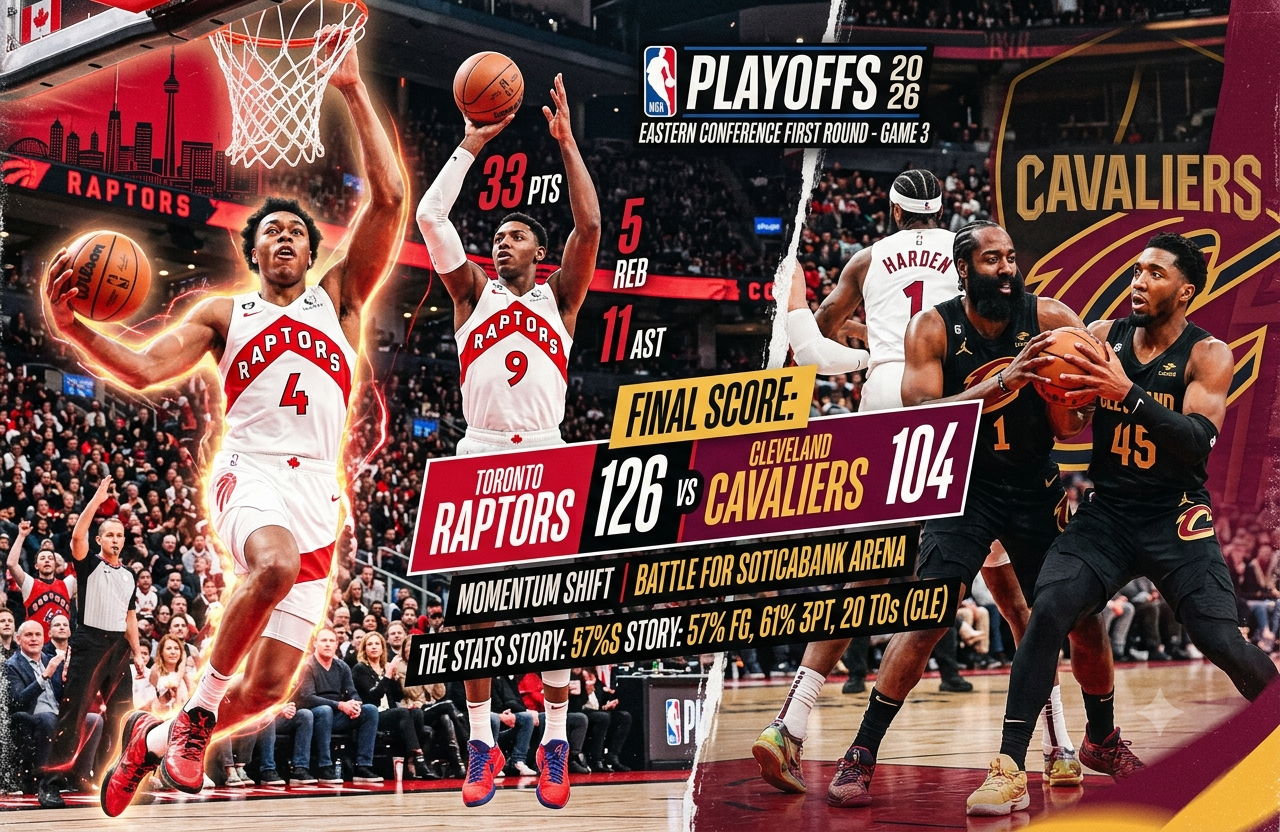
Cleveland Cavaliers vs Toronto Raptors Match Player Stats
The Cleveland Cavaliers vs Toronto Raptors match player stats from Game 3 of the 2026 NBA Playoffs tell the story of one of the biggest momentum shifts in the Eastern Conference First Round. After Cleveland narrowly won the opening two games, Toronto responded with an emphatic 126 to 104 victory at Scotiabank Arena on April 24, 2026. While the final score alone highlights Toronto’s dominance, the player statistics reveal exactly why the Raptors controlled nearly every aspect of the contest.
This matchup demonstrated how efficient shooting, disciplined ball movement, and timely defensive plays can completely change a playoff series. Toronto produced one of its most balanced offensive performances of the season, while Cleveland struggled with turnovers and inconsistent shooting despite several solid individual efforts. In this detailed analysis, we break down every important statistic, examine the performances of the key players, and explain how each number influenced the outcome of this crucial playoff game.
Match Overview
| Match Detail | Information |
| Event | Toronto Raptors vs Cleveland Cavaliers |
| Competition | NBA Playoffs, Eastern Conference First Round Game 3 |
| Date | April 24, 2026 |
| Venue | Scotiabank Arena, Toronto |
| Attendance | 19,800 |
| Final Score | Toronto Raptors 126, Cleveland Cavaliers 104 |
| Series Before Game | Cleveland led 2 to 0 |
| Television | Prime Video |
Game 3 carried enormous importance for both teams. Cleveland entered Toronto with confidence after winning the first two games by slim margins. Toronto, however, understood that another defeat would place them in an extremely difficult position.
Instead of playing cautiously, the Raptors attacked from the opening possession. Their aggressive offense, efficient shooting, and improved defensive execution completely changed the direction of the series.
Cleveland Cavaliers vs Toronto Raptors Match Player Stats: Complete Team Comparison
Before looking at individual performances, comparing the overall team numbers helps explain why Toronto earned such a convincing victory.
| Team Statistics | Cleveland Cavaliers | Toronto Raptors |
| Points | 104 | 126 |
| Field Goals | 36 of 81 (44%) | 50 of 87 (57%) |
| Three Pointers | 14 of 45 (31%) | 14 of 23 (61%) |
| Free Throws | 18 of 23 (78%) | 12 of 21 (57%) |
| Rebounds | 42 | 35 |
| Assists | 23 | 29 |
| Turnovers | 20 | 11 |
| Steals | 7 | 11 |
| Blocks | 6 | 4 |
Several trends immediately stand out.
Toronto shot 57 percent from the field while Cleveland managed only 44 percent. The Raptors also connected on an incredible 61 percent of their three point attempts despite taking almost half as many shots from beyond the arc.
Perhaps the biggest difference came in ball security. Cleveland committed 20 turnovers compared to Toronto’s 11. Those extra possessions consistently allowed the Raptors to build momentum throughout the game.
Quarter by Quarter Breakdown
| Quarter | Cavaliers | Raptors |
| First | 25 | 31 |
| Second | 29 | 23 |
| Third | 27 | 29 |
| Fourth | 23 | 43 |
The opening quarter established Toronto’s aggressive approach as they built an early six point lead.
Cleveland recovered well during the second period by outscoring Toronto, reducing the halftime deficit.
The third quarter remained competitive, but everything changed in the final twelve minutes.
Toronto exploded for 43 fourth quarter points while Cleveland managed only 23. That remarkable closing stretch transformed a competitive playoff game into a comfortable victory.
Toronto Raptors Player Performance Analysis
Toronto’s balanced attack made them extremely difficult to defend. Multiple players contributed in different ways rather than relying on one superstar.
RJ Barrett Delivers His Best Playoff Performance
The RJ Barrett produced one of the finest playoff games of his career.
RJ Barrett Statistics
| Category | Total |
| Points | 33 |
| Rebounds | 5 |
| Assists | 5 |
| Field Goals | 12 of 19 |
| Three Pointers | 6 of 8 |
Barrett consistently punished Cleveland’s defense by mixing aggressive drives with elite perimeter shooting. His six made three pointers stretched the Cavaliers’ defense and created additional opportunities for teammates.
His offensive efficiency became one of the defining stories of Game 3.
Scottie Barnes Controlled Every Phase
Scottie Barnes once again proved why he is considered one of the NBA’s most complete young stars.
| Category | Total |
| Points | 33 |
| Rebounds | 5 |
| Assists | 11 |
| Field Goals | 11 of 17 |
Barnes did much more than score.
His eleven assists reflected outstanding court vision and decision making. Throughout the game he consistently found open shooters while also creating scoring opportunities for himself.
When Toronto needed leadership, Barnes provided it on both ends of the floor.
Collin Murray-Boyles Sparked the Bench
One of the biggest surprises came from Toronto’s bench.
| Category | Total |
| Points | 22 |
| Rebounds | 8 |
His energy completely changed several stretches of the game.
Bench production often determines playoff success, and Murray-Boyles ensured Toronto maintained its offensive pressure whenever the starters rested.
Supporting Contributions
Several additional Raptors quietly made valuable contributions.
Brandon Ingram
- 12 points
- 3 rebounds
- 2 assists
Jakob Poeltl
- 8 points
- 6 rebounds
- 2 assists
Although neither player posted spectacular numbers, both filled important roles by defending well, setting screens, and making smart decisions with the basketball.
What This Result Meant for the Playoff Series
Game 3 was more than just Toronto’s first victory of the series. It completely changed the competitive balance and restored the Raptors’ confidence after two heartbreaking losses.
The first two games had been decided by only three combined points.
- Game 1: Cavaliers 115, Raptors 113
- Game 2: Cavaliers 105, Raptors 104
Those narrow defeats showed Toronto was capable of competing with Cleveland despite trailing in the series. Game 3 proved that when the Raptors executed their game plan efficiently, they could control the matchup from start to finish.
The series eventually became one of the most competitive first round battles in the Eastern Conference.
| Game | Result |
| Game 1 | Cavaliers 115, Raptors 113 |
| Game 2 | Cavaliers 105, Raptors 104 |
| Game 3 | Raptors 126, Cavaliers 104 |
| Game 4 | Raptors 93, Cavaliers 89 |
| Game 5 | Cavaliers 125, Raptors 120 |
| Game 6 | Cavaliers 112, Raptors 110 (OT) |
| Game 7 | Cavaliers 114, Raptors 102 |
Although Cleveland ultimately won the series in seven games, Toronto’s performance in Game 3 demonstrated why playoff basketball is rarely predictable. Momentum can change quickly when a team improves its shooting efficiency, limits turnovers, and receives major contributions from multiple players.
Biggest Statistical Takeaways
Looking back at the Cleveland Cavaliers vs Toronto Raptors match player stats, several numbers stand out as the biggest reasons behind Toronto’s victory.
Toronto’s Shooting Was the Difference
The Raptors finished the night shooting:
- 57 percent from the field
- 61 percent from three point range
Those percentages are exceptional for any NBA game, especially in the playoffs where defenses become more physical and possessions carry greater importance.
Scottie Barnes Controlled the Entire Game
Barnes delivered one of the most complete playoff performances of the series.
His final stat line included:
- 33 points
- 5 rebounds
- 11 assists
He impacted scoring, playmaking, and leadership while maintaining excellent shooting efficiency.
RJ Barrett Matched Barnes’ Offensive Production
Barrett also scored 33 points while making six three pointers.
His ability to score from both the perimeter and inside the paint forced Cleveland into difficult defensive decisions throughout the game.
Cleveland Lost the Turnover Battle
Turnovers often determine playoff outcomes.
The Cavaliers committed 20 turnovers, while Toronto committed only 11.
Those additional possessions helped Toronto build scoring runs, particularly during the fourth quarter.
Bench Production Favored Toronto
Collin Murray-Boyles gave Toronto an enormous lift off the bench with:
- 22 points
- 8 rebounds
Meanwhile, Cleveland’s leading reserve, Max Strus, scored 15 points.
Toronto’s second unit maintained the team’s offensive intensity whenever the starters rested.
Lessons Coaches Can Take From This Match
This playoff game offers several tactical lessons that extend beyond one series.
Efficient Shooting Beats High Volume Shooting
Cleveland attempted far more three pointers than Toronto, yet the Raptors were dramatically more efficient.
Quality shot selection consistently outweighed quantity.
Ball Movement Creates Better Offense
Toronto’s 29 assists reflected excellent teamwork.
Instead of relying on isolation basketball, the Raptors repeatedly created open shots through smart passing and off-ball movement.
Limiting Turnovers Wins Playoff Games
Every extra possession matters in the postseason.
Toronto’s disciplined ball handling prevented Cleveland from generating easy transition points.
Balanced Scoring Is Harder to Defend
Toronto had multiple players producing at a high level.
Rather than depending on a single superstar, the Raptors received meaningful contributions from their starters and bench, making defensive adjustments much more difficult.
Frequently Asked Questions
Who was the leading scorer in the Cleveland Cavaliers vs Toronto Raptors playoff game?
RJ Barrett and Scottie Barnes shared the scoring lead with 33 points each for Toronto.
Who recorded the most assists in the game?
Scottie Barnes led all players with 11 assists while also scoring 33 points.
Why did Toronto defeat Cleveland in Game 3?
Toronto won because of outstanding shooting efficiency, better ball movement, fewer turnovers, and a dominant fourth quarter in which the Raptors outscored Cleveland 43 to 23.
Which Cleveland player scored the most points?
James Harden finished as Cleveland’s leading scorer with 18 points.
How many turnovers did each team commit?
Cleveland committed 20 turnovers, while Toronto committed 11.
Who won the playoff series?
Cleveland Cavaliers won the Eastern Conference First Round series four games to three after winning Game 7 by a score of 114 to 102.
Conclusion
The Cleveland Cavaliers vs Toronto Raptors match player stats provide a clear explanation of how Toronto earned its convincing 126 to 104 victory in Game 3 of the 2026 Eastern Conference First Round.
While Cleveland entered the contest with a two game series lead, Toronto responded with one of its most efficient performances of the postseason. RJ Barrett and Scottie Barnes each scored 33 points, Barnes added 11 assists, and the Raptors shot an outstanding 57 percent from the field while limiting themselves to only 11 turnovers. Cleveland received respectable performances from James Harden, Evan Mobley, Donovan Mitchell, and Jarrett Allen, but the combination of inefficient shooting, 20 turnovers, and Toronto’s explosive 43 point fourth quarter proved too much to overcome.
Although the Cavaliers eventually advanced by winning the series in seven games, Game 3 remains one of the defining moments of the matchup. It showcased how disciplined offense, efficient shot selection, and balanced team play can completely reshape the momentum of a playoff series.