Phoenix Suns vs Lakers Match Player Stats
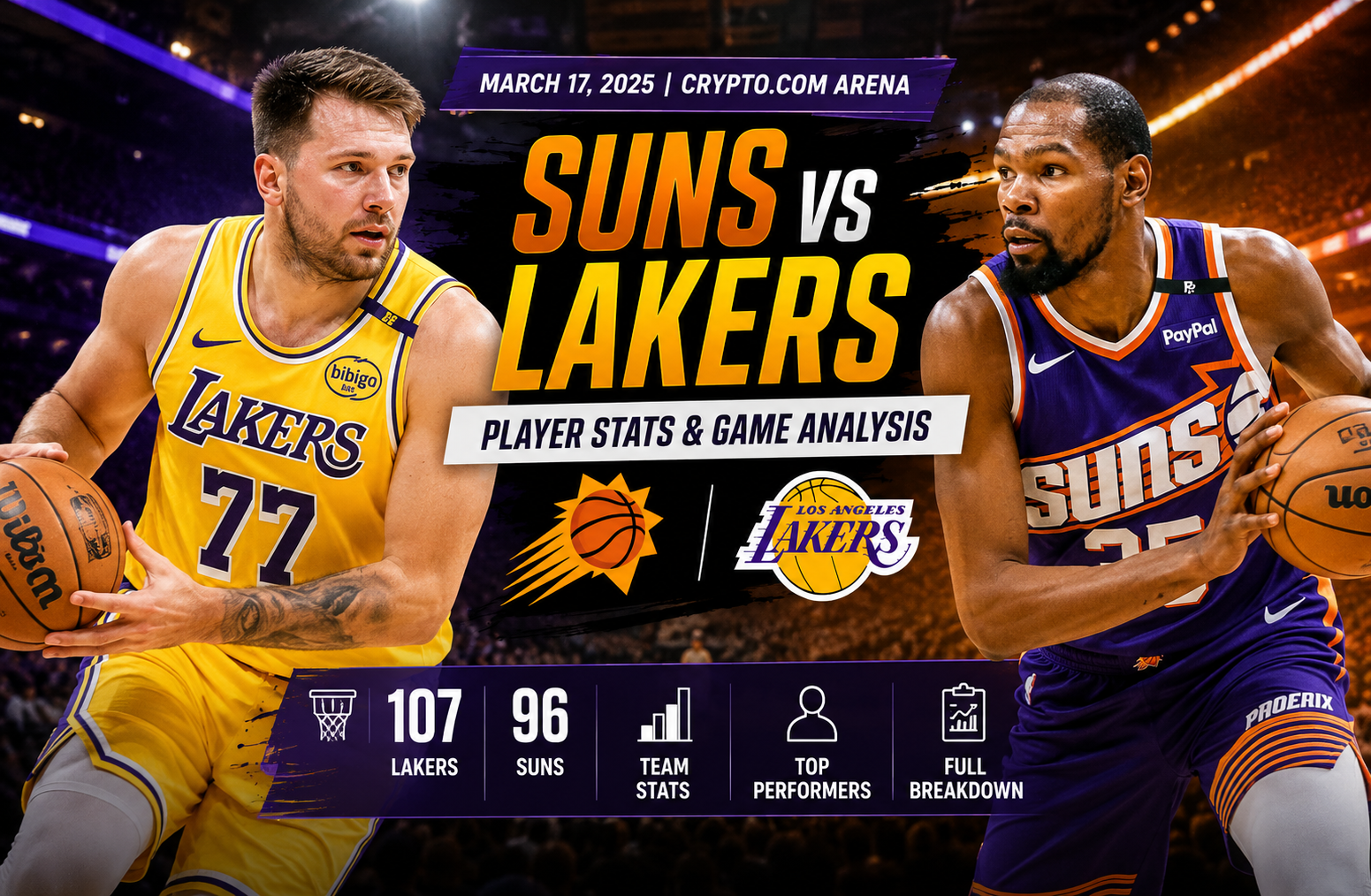
The phoenix suns vs lakers match player stats from the March 17, 2025 meeting tell the story of a game that was decided by efficiency, disciplined defense, and standout individual performances. Played at Crypto.com Arena in Los Angeles, the contest featured elite NBA talent including Luka Doncic, Kevin Durant, Devin Booker, and Austin Reaves. While the Phoenix Suns fought back after a slow opening quarter, the Los Angeles Lakers maintained control and secured a 107 to 96 victory in front of 18,997 fans.
Rather than focusing only on the final score, examining the statistics reveals why the Lakers earned the win. Shooting percentages, turnovers, rebounding, assists, and star performances all contributed to the outcome. This article provides a complete statistical breakdown, explains what each number means, and highlights the performances that shaped one of the season’s most talked-about Pacific Division matchups.
Match Overview
| Match Details | Information |
| Game | Phoenix Suns vs Los Angeles Lakers |
| Date | March 17, 2025 |
| Venue | Crypto.com Arena, Los Angeles, California |
| Attendance | 18,997 |
| Final Score | Los Angeles Lakers 107, Phoenix Suns 96 |
| TV Broadcast | ABC, ESPN+ |
| Referees | James Capers, Nick Buchert, Brandon Adair |
The Lakers entered the game with a 41 to 25 record and one of the league’s strongest home records at 26 wins and 7 losses. Phoenix arrived with a 31 to 37 overall record and had struggled on the road throughout the season, holding a 12 to 24 away record.
Those season trends continued during this matchup. Los Angeles established an early lead, controlled the pace, and limited mistakes throughout the game.
Phoenix Suns vs Lakers Match Player Stats
This section presents the complete player and team statistics from the matchup.
Final Score
| Team | Points |
| Los Angeles Lakers | 107 |
| Phoenix Suns | 96 |
The eleven-point margin reflected the Lakers’ ability to capitalize on offensive opportunities while forcing Phoenix into inefficient shooting nights from beyond the arc.
Quarter by Quarter Score
| Quarter | Phoenix Suns | Los Angeles Lakers |
| First Quarter | 15 | 31 |
| Second Quarter | 22 | 23 |
| Third Quarter | 34 | 29 |
| Fourth Quarter | 25 | 24 |
| Final | 96 | 107 |
The opening quarter proved decisive.
Los Angeles outscored Phoenix by 16 points in the first twelve minutes. Although the Suns responded with an impressive third quarter, reducing the deficit through improved offensive execution, the Lakers never surrendered control of the contest.
Team Statistics Comparison
| Statistic | Phoenix Suns | Los Angeles Lakers |
| Points | 96 | 107 |
| Field Goals | 35 of 89 (39%) | 35 of 81 (43%) |
| Three Pointers | 9 of 41 (22%) | 14 of 39 (36%) |
| Free Throws | 17 of 21 (81%) | 23 of 32 (72%) |
| Total Rebounds | 51 | 40 |
| Assists | 25 | 22 |
| Turnovers | 14 | 8 |
| Steals | 4 | 7 |
| Blocks | 4 | 5 |
These numbers explain the game better than the final score alone.
Phoenix actually collected more rebounds and recorded more assists, but those advantages were overshadowed by three critical areas.
First, the Suns struggled from three-point range, making only 22 percent of their attempts.
Second, Los Angeles protected the basketball exceptionally well with just eight turnovers.
Finally, the Lakers converted five more three-pointers despite attempting fewer total shots.
Lakers Player Statistics
Luka Doncic
| Statistic | Total |
| Points | 33 |
| Rebounds | 11 |
| Assists | 8 |
Luka Doncic delivered one of his most complete performances of the season. His 33 points led all scorers, while his 11 rebounds completed a double-double. Adding eight assists demonstrated his ability to control every aspect of the offense.
Beyond the box score, Doncic consistently created quality scoring opportunities, dictated the tempo, and forced Phoenix’s defense into difficult decisions.
Austin Reaves
| Statistic | Total |
| Points | 28 |
| Assists | 6 |
Austin Reaves provided outstanding secondary scoring.
His 28 points gave the Lakers another reliable offensive option whenever Phoenix focused defensive attention on Doncic. Reaves also contributed six assists, showing his value as both a scorer and facilitator.
Jaxson Hayes
| Statistic | Total |
| Points | 19 |
Jaxson Hayes played one of his strongest offensive games, finishing with 19 points. His interior scoring complemented the Lakers’ perimeter shooting and helped maintain offensive balance throughout the evening.
Phoenix Suns Player Statistics
Kevin Durant
| Statistic | Total |
| Points | 21 |
| Rebounds | 9 |
Kevin Durant once again demonstrated why he remains one of the NBA’s elite scorers.
His 21 points kept Phoenix within striking distance for much of the game, while his nine rebounds led the Suns on the glass. Although he narrowly missed a double-double, Durant remained Phoenix’s most consistent offensive threat.
Devin Booker
| Statistic | Total |
| Points | 19 |
| Rebounds | 6 |
| Assists | 11 |
Devin Booker produced an excellent all-around performance.
While his scoring total was slightly below his season averages, his 11 assists reflected his commitment to creating opportunities for teammates. Booker effectively balanced scoring and playmaking throughout the contest.
Statistical Leaders
Los Angeles Lakers
| Category | Leader | Total |
| Points | Luka Doncic | 33 |
| Rebounds | Luka Doncic | 11 |
| Assists | Luka Doncic | 8 |
Doncic led the Lakers in every major statistical category, highlighting his influence on both ends of the floor.
Phoenix Suns
| Category | Leader | Total |
| Points | Kevin Durant | 21 |
| Rebounds | Kevin Durant | 9 |
| Assists | Devin Booker | 11 |
Phoenix relied heavily on Durant and Booker, but the supporting cast was unable to provide enough offensive production to overcome the Lakers’ balanced attack.
Why the Lakers Won
Several statistical factors separated the two teams.
Superior Three Point Shooting
Los Angeles converted 14 three-pointers while Phoenix made only nine.
This 15-point difference from long range significantly influenced the final margin.
Better Ball Security
Turnovers often determine close NBA games.
The Lakers committed only eight turnovers compared to Phoenix’s fourteen, creating additional scoring opportunities while limiting easy transition baskets for the Suns.
Efficient First Quarter
The opening period established the tone.
Los Angeles built a 31 to 15 advantage, forcing Phoenix to spend the remainder of the game attempting to erase a sizeable deficit. Although the Suns won the third quarter, overcoming such a large early gap proved too difficult.
Star Performances at the Right Time
Luka Doncic delivered 33 points, 11 rebounds, and eight assists, while Austin Reaves added 28 points.
Phoenix received productive outings from Kevin Durant and Devin Booker, but the Lakers enjoyed greater scoring depth, with Jaxson Hayes contributing 19 points.
Breaking Down the Shooting Numbers
One of the most revealing aspects of this matchup was shooting efficiency.
Phoenix attempted eight more field goals than Los Angeles, yet both teams made exactly 35 baskets.
This illustrates the importance of shot quality rather than shot quantity.
The Suns shot just 39 percent from the field and 22 percent from beyond the arc. Those percentages made it difficult to capitalize on their rebounding advantage and extra possessions.
In contrast, the Lakers finished with 43 percent overall shooting and 36 percent from three-point range. Their improved perimeter efficiency stretched Phoenix’s defense and created additional scoring opportunities inside the paint.
Advanced Analysis of the Team Statistics
Looking beyond the final score provides a clearer understanding of how Los Angeles controlled this game. Basketball games are rarely decided by one statistic alone. Instead, they are influenced by a combination of shooting efficiency, possession management, defensive execution, and timely scoring. Every major category from this matchup supports the Lakers’ victory.
Although Phoenix finished with more rebounds and assists, those advantages were offset by poor shooting from three point range and a higher number of turnovers. The Lakers were simply more efficient with the possessions they created.
Field Goal Efficiency
Both teams made exactly 35 field goals, but there was an important difference in the number of attempts.
| Team | Made | Attempted | Percentage |
| Lakers | 35 | 81 | 43% |
| Suns | 35 | 89 | 39% |
The Suns required eight additional shot attempts to score the same number of baskets.
This difference may appear small at first, but over the course of an NBA game it represents several empty possessions. Efficient offenses consistently maximize scoring opportunities, and Los Angeles accomplished that throughout the evening.
Three Point Shooting Changed the Game
Perimeter shooting often separates evenly matched teams, and that was certainly true in this contest.
| Team | Three Pointers | Percentage |
| Lakers | 14 of 39 | 36% |
| Suns | 9 of 41 | 22% |
The Lakers connected on five more three pointers than Phoenix.
Since each successful three pointer is worth an extra point compared to a standard field goal, that difference alone created a fifteen point advantage from beyond the arc. Considering the final margin was eleven points, outside shooting became one of the defining reasons for the Lakers’ victory.
Phoenix generated open opportunities but struggled to convert them consistently. Those missed perimeter shots also reduced second chance scoring opportunities because long rebounds frequently favored the Lakers.
Ball Movement and Playmaking
Passing remained one of the strengths of both teams.
| Team | Assists |
| Suns | 25 |
| Lakers | 22 |
Phoenix actually recorded three more assists than Los Angeles, showing that the offense continued to create quality ball movement despite the loss.
Devin Booker played a major role in this category with 11 assists, consistently finding teammates in scoring positions.
The Lakers, however, demonstrated that efficient scoring can outweigh a slight assist deficit. Luka Doncic repeatedly created offense through both passing and individual shot creation, allowing Los Angeles to maintain offensive balance.
Rebounding Battle
Rebounding statistics often determine which team controls possession.
| Team | Total Rebounds |
| Suns | 51 |
| Lakers | 40 |
Phoenix dominated the glass with an eleven rebound advantage.
Kevin Durant led the Suns with nine rebounds, helping Phoenix generate additional offensive opportunities.
Despite losing the rebounding battle, Los Angeles minimized the impact by committing fewer turnovers and converting a higher percentage of their scoring chances.
This illustrates an important basketball principle.
Winning one statistical category does not automatically result in winning the game. Efficiency across multiple areas is usually more valuable than dominance in a single category.
Turnovers Made a Significant Difference
Few statistics had a greater influence on the outcome than turnovers.
| Team | Turnovers |
| Lakers | 8 |
| Suns | 14 |
The Lakers protected possession exceptionally well.
Giving the ball away only eight times meant Phoenix received very few easy transition opportunities.
Meanwhile, the Suns surrendered possession fourteen times. Each turnover represented a lost scoring chance while often allowing the Lakers to attack before Phoenix’s defense could get organized.
Throughout an NBA season, coaches consistently emphasize ball security because even a handful of unnecessary turnovers can completely change momentum.
That lesson was evident throughout this game.
Defensive Contributions
Defense extends beyond blocked shots.
It includes forcing difficult shots, disrupting passing lanes, limiting transition opportunities, and maintaining disciplined positioning.
| Category | Suns | Lakers |
| Steals | 4 | 7 |
| Blocks | 4 | 5 |
Los Angeles produced more steals and more blocks.
Those extra defensive plays created additional possessions while preventing Phoenix from establishing consistent offensive rhythm.
Even when the Suns executed quality offensive sets, the Lakers frequently contested shots without committing unnecessary fouls.
Quarter by Quarter Tactical Breakdown
First Quarter
The opening quarter determined the direction of the game.
Phoenix scored only 15 points while Los Angeles exploded for 31.
Several factors contributed to this early gap.
The Lakers defended aggressively around the perimeter.
They forced difficult outside shots.
Their offense attacked quickly before Phoenix’s defense became organized.
Starting a game with a sixteen point advantage allows a team to dictate pace rather than chase momentum.
For Phoenix, recovering from such a slow beginning became an enormous challenge.
Second Quarter
The second period was considerably more balanced.
Los Angeles edged Phoenix 23 to 22.
Neither team established complete control, but maintaining the lead benefited the Lakers.
Instead of attempting risky offensive possessions, Los Angeles focused on maintaining efficiency while avoiding mistakes.
Phoenix improved defensively but still struggled to reduce the overall deficit.
Third Quarter
This was the Suns’ strongest stretch.
Phoenix outscored Los Angeles 34 to 29.
Kevin Durant became increasingly aggressive, while Devin Booker expanded his playmaking role.
The improved offensive execution briefly shifted momentum toward Phoenix.
Unfortunately for the Suns, the earlier deficit remained too large to erase completely.
Fourth Quarter
Both teams scored at a similar pace during the final period.
Phoenix managed 25 points.
Los Angeles finished with 24.
Rather than forcing difficult shots, the Lakers emphasized smart possessions, free throw opportunities, and defensive discipline.
This mature closing approach prevented Phoenix from making one final comeback attempt.
Luka Doncic Controlled Every Aspect of the Game
The Lakers’ offense revolved around Luka Doncic, and his production reflected complete control.
Luka Doncic Statistics
| Category | Total |
| Points | 33 |
| Rebounds | 11 |
| Assists | 8 |
Scoring 33 points while nearly recording a triple double demonstrates remarkable versatility.
Rather than functioning solely as a scorer, Doncic influenced nearly every offensive possession.
When Phoenix defended him aggressively, he created scoring chances for teammates.
When defenders stayed home on shooters, he attacked the basket himself.
This ability to adapt makes elite players exceptionally difficult to defend over an entire game.
Austin Reaves also deserves recognition.
His 28 points prevented Phoenix from focusing all defensive attention on Doncic.
Having multiple scoring threats forced the Suns into difficult defensive decisions throughout the evening.
Jaxson Hayes added another 19 points, giving Los Angeles valuable interior production that complemented its perimeter shooting.
Together, those three players accounted for 80 of the Lakers’ 107 total points, illustrating how effectively the team’s primary contributors executed their offensive roles.
What the Statistics Mean for the Phoenix Suns
The numbers from this game reveal several positives for Phoenix despite the loss.
The Suns won the rebounding battle by a comfortable margin and finished with more assists than the Lakers. Those two categories usually indicate good ball movement and strong effort on the glass. Kevin Durant and Devin Booker continued to perform at an elite level, combining for 40 points while Booker added 11 assists.
However, the statistics also highlight the areas that prevented Phoenix from competing for the win in the closing minutes.
The biggest concern was perimeter shooting. Converting only 9 of 41 three point attempts resulted in a 22 percent success rate, well below what is generally needed to defeat a playoff caliber opponent. Modern NBA offenses rely heavily on efficient outside shooting, and the Suns were unable to capitalize on the open looks they created.
Turnovers also played a major role. Fourteen turnovers may not seem excessive over a full game, but against a disciplined team like the Lakers, every lost possession becomes increasingly costly. Los Angeles converted many of those extra opportunities into valuable points while avoiding similar mistakes themselves.
From a statistical perspective, Phoenix showed that its offensive structure remained effective enough to generate scoring chances. The challenge was converting those opportunities with greater consistency.
What the Statistics Mean for the Los Angeles Lakers
Los Angeles demonstrated why efficiency often outweighs volume in professional basketball.
The Lakers attempted fewer shots, collected fewer rebounds, and recorded fewer assists than Phoenix. Yet they comfortably won the game because they excelled in the categories that most directly influence the scoreboard.
Better field goal efficiency, stronger three point shooting, fewer turnovers, and timely defensive plays allowed the Lakers to control the game from start to finish.
Luka Doncic once again proved capable of impacting every phase of the contest. His 33 points, 11 rebounds, and 8 assists represent the type of all around performance expected from one of the league’s premier players.
Austin Reaves continued to establish himself as one of the NBA’s most reliable secondary scorers. His 28 points ensured the offensive burden did not fall entirely on Doncic, while Jaxson Hayes added valuable interior scoring that balanced the Lakers’ attack.
Perhaps the most encouraging statistic for Los Angeles was its turnover total.
Protecting the basketball while maintaining offensive efficiency reflects disciplined execution, something successful teams consistently demonstrate throughout long NBA seasons.
Season Series Review
The March 17 matchup completed the regular season series between Phoenix and Los Angeles.
| Game | Result |
| October 26, 2024 | Suns 123, Lakers 116 |
| October 29, 2024 | Lakers 109, Suns 105 |
| November 27, 2024 | Lakers 127, Suns 100 |
| March 17, 2025 | Lakers 107, Suns 96 |
The season series finished tied at two wins each according to the provided data.
Although both teams claimed victories, the final meeting illustrated how competitive the rivalry remained. Every game presented different statistical leaders and different tactical adjustments, making each contest unique.
Key Takeaways from the Game
Several important lessons emerge when reviewing the complete statistical profile of this matchup.
- The first quarter established the foundation for the Lakers’ victory.
- Luka Doncic delivered the most influential individual performance of the game with 33 points, 11 rebounds, and 8 assists.
- Austin Reaves provided elite secondary scoring with 28 points.
- Kevin Durant remained Phoenix’s leading scorer with 21 points and nine rebounds.
- Devin Booker contributed a strong all around performance, recording 19 points and 11 assists.
- The Lakers shot more efficiently from both the field and three point range.
- Phoenix dominated rebounding but could not convert enough perimeter shots.
- Los Angeles committed only eight turnovers, demonstrating excellent ball security.
- Defensive pressure from the Lakers limited Phoenix’s offensive rhythm throughout the contest.
Why This Game Stands Out
Games between the Suns and Lakers regularly attract attention because both franchises feature accomplished players and have long been contenders in the Western Conference.
This particular matchup showcased two contrasting approaches.
Phoenix relied heavily on rebounding, ball movement, and the creativity of Durant and Booker.
Los Angeles emphasized efficient scoring, disciplined defense, and exceptional decision making from Luka Doncic.
From an analytical standpoint, the contest serves as a strong example of why efficiency metrics often explain victories more accurately than traditional counting statistics alone.
Although Phoenix won several statistical categories, Los Angeles excelled in the areas that directly translated into points.
For readers interested in advanced basketball analysis, the NBA Stats database provides additional league wide statistical context and advanced metrics.
Frequently Asked Questions
What was the final score between the Suns and Lakers on March 17, 2025?
The Los Angeles Lakers defeated the Phoenix Suns by a final score of 107 to 96 at Crypto.com Arena.
Who scored the most points in the game?
Luka Doncic led all players with 33 points while also contributing 11 rebounds and 8 assists.
Who was the leading scorer for the Phoenix Suns?
Kevin Durant finished as Phoenix’s leading scorer with 21 points while adding nine rebounds.
Which player recorded the most assists?
Devin Booker led all players with 11 assists for the Suns.
Why did the Lakers win the game?
The Lakers shot more efficiently from the field and three point range, committed only eight turnovers, and received outstanding performances from Luka Doncic, Austin Reaves, and Jaxson Hayes.
How did the regular season series finish?
Based on the provided data, the season series between the Suns and Lakers finished tied at two wins each.
Conclusion
The phoenix suns vs lakers match player stats demonstrate that basketball games are decided by much more than total points or individual scoring performances. Los Angeles combined efficient shooting, disciplined ball control, and impactful defense to secure a convincing 107 to 96 victory over Phoenix.
Luka Doncic produced the game’s defining performance with 33 points, 11 rebounds, and 8 assists, while Austin Reaves supplied valuable secondary scoring. For Phoenix, Kevin Durant and Devin Booker continued to lead the offense, but the team’s struggles from three point range and higher turnover count ultimately proved difficult to overcome.
When viewed as a complete statistical picture, this matchup highlights how efficiency, smart decision making, and balanced contributions across the roster often separate winning teams from losing ones. The numbers from this game provide valuable insight into both teams’ strengths and weaknesses and explain why the Lakers emerged with the victory.