Dallas Cowboys vs Detroit Lions Match Player Stats
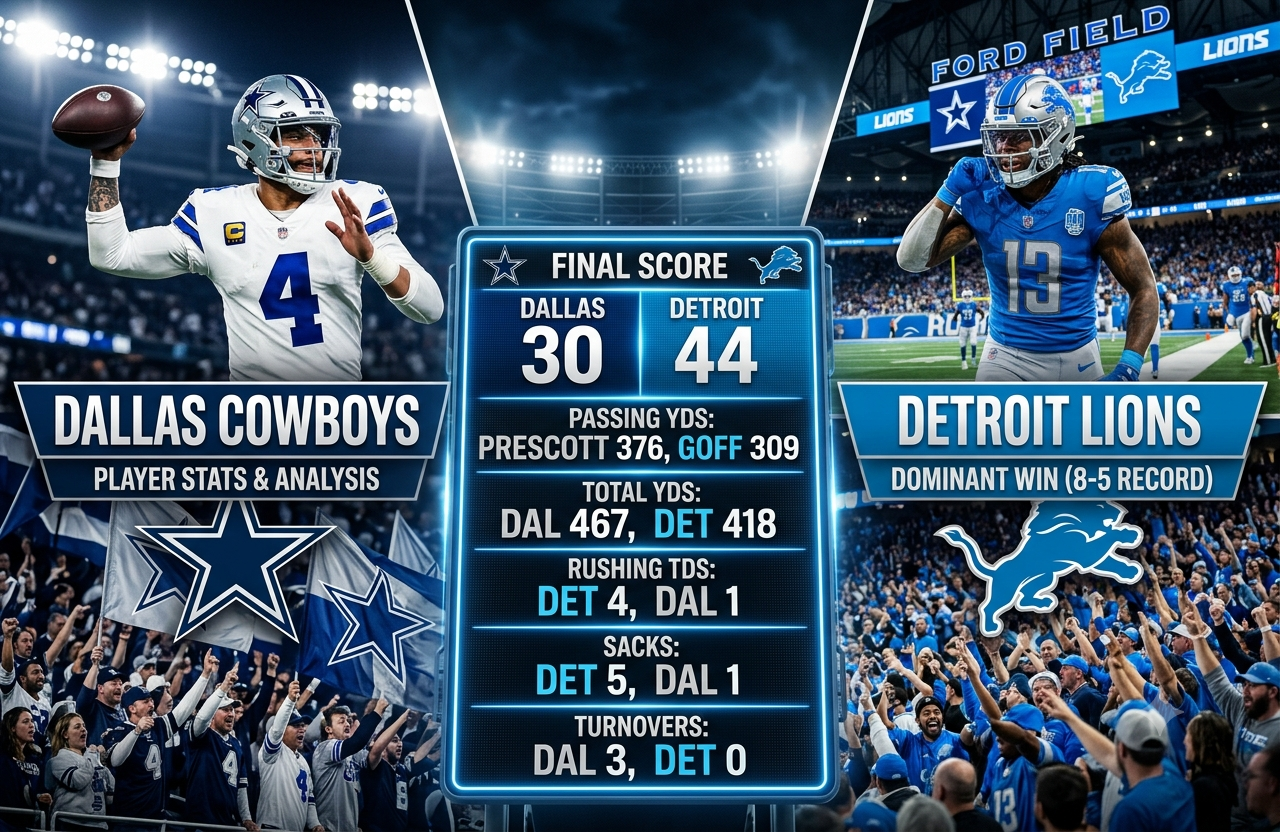
The dallas cowboys vs detroit lions match player stats tell the story of a game that was far more competitive than the final score might suggest. On December 5, 2025, the Detroit Lions defeated the Dallas Cowboys 44-30 in an NFL matchup that showcased explosive offense, efficient quarterback play, dominant defensive pressure, and a decisive rushing attack from Detroit. While Dallas generated significant yardage through the air, critical turnovers and defensive breakdowns prevented them from keeping pace with a Lions team that capitalized on nearly every opportunity.
Played at Detroit’s home venue, the contest featured standout performances from Jared Goff, Jahmyr Gibbs, David Montgomery, Dak Prescott, CeeDee Lamb, and several key defensive contributors. For fans, analysts, and fantasy football enthusiasts, this game provided valuable insights into how efficiency, ball security, and red-zone execution can determine outcomes at the highest level of professional football.
This detailed breakdown examines every major statistical category, highlights the most influential players, and explains how Detroit secured a convincing victory despite facing one of the league’s most recognizable franchises.
Match Overview
| Match Detail | Result |
| Event | Detroit Lions vs Dallas Cowboys |
| Date | December 5, 2025 |
| Competition | NFL |
| Venue Status | Detroit Home Game |
| Final Score | Detroit Lions 44, Dallas Cowboys 30 |
| Detroit Record | 8-5 |
| Dallas Record | 6-6-1 |
The final score reflected Detroit’s ability to dominate key situations throughout the game. Although Dallas moved the football effectively through the air, the Lions consistently responded with scoring drives and game-changing defensive plays.
Quarter-by-Quarter Score Breakdown
| Team | Q1 | Q2 | Q3 | Q4 | Total |
| Dallas Cowboys | 3 | 6 | 10 | 11 | 30 |
| Detroit Lions | 10 | 10 | 7 | 17 | 44 |
Detroit established control early and maintained pressure throughout the contest. Their strongest period came in the fourth quarter, where they scored 17 points and effectively put the game out of reach.
Dallas Cowboys vs Detroit Lions Match Player Stats: Complete Team Analysis
When reviewing the dallas cowboys vs detroit lions match player stats, several numbers immediately stand out.
Detroit produced:
- 44 total points
- 109 rushing yards
- 309 passing yards
- 4 rushing touchdowns
- 5 sacks
- 2 interceptions
Dallas generated:
- 30 total points
- 376 passing yards
- 91 rushing yards
- 1 rushing touchdown
- 1 passing touchdown
- 3 fumbles
The most significant difference was efficiency. Detroit converted scoring opportunities into touchdowns, while Dallas struggled with turnovers and protection issues.
Quarterback Comparison
Quarterback play often determines the outcome of NFL games, and this matchup offered an excellent contrast between efficiency and volume.
Jared Goff Performance
| Stat | Value |
| Completions/Attempts | 25/34 |
| Passing Yards | 309 |
| Touchdowns | 1 |
| Interceptions | 0 |
| Passer Rating | 111.0 |
Jared Goff delivered one of his most efficient performances of the season. Completing 25 of 34 passes, he consistently found open receivers while avoiding risky throws.
What impressed observers most was his decision-making. Rather than forcing passes into coverage, Goff took what the defense gave him and allowed Detroit’s balanced offensive attack to thrive.
A passer rating of 111.0 demonstrates how effectively he managed the game. In many NFL contests, avoiding turnovers is just as valuable as producing touchdowns, and Goff accomplished both objectives.
Dak Prescott Performance
| Stat | Value |
| Completions/Attempts | 31/47 |
| Passing Yards | 376 |
| Touchdowns | 1 |
| Interceptions | 2 |
| Passer Rating | 79.7 |
At first glance, Dak Prescott’s 376 passing yards appear impressive. He completed 31 passes and repeatedly pushed the ball downfield.
However, the two interceptions proved costly.
While Prescott generated more passing yardage than Goff, the turnovers shifted momentum toward Detroit and gave the Lions additional opportunities to score. Combined with five sacks allowed by the Dallas offensive line, Prescott spent much of the game under pressure.
From an analytical perspective, this performance highlights an important football principle: efficiency often outweighs volume.
Goff produced fewer passing yards but delivered the cleaner and ultimately more impactful performance.
Running Game Breakdown
The running game became one of the most important factors in determining the winner.
Detroit Lions Rushing Attack
| Stat | Value |
| Team Carries | 22 |
| Team Rushing Yards | 109 |
| Team Rushing TDs | 4 |
Detroit’s rushing offense was exceptionally productive in scoring situations.
The Lions accumulated four rushing touchdowns, demonstrating their ability to dominate near the goal line.
David Montgomery
| Stat | Value |
| Carries | 6 |
| Yards | 60 |
| Touchdowns | 1 |
Montgomery averaged an outstanding 10 yards per carry. Every time he touched the football, he created positive yardage and forced Dallas defenders to make difficult tackles in space.
Jahmyr Gibbs
| Stat | Value |
| Rushing Touchdowns | 3 |
Although Gibbs’ rushing yardage total was not the headline statistic, his three rushing touchdowns became one of the defining elements of the game.
Scoring three times on the ground demonstrates remarkable effectiveness in critical situations.
His ability to finish drives ensured that Detroit maximized scoring opportunities throughout the contest.
Dallas Cowboys Rushing Attack
| Stat | Value |
| Team Carries | 24 |
| Team Rushing Yards | 91 |
| Team Rushing TDs | 1 |
Dallas attempted to maintain offensive balance, but the running game never reached the same level of effectiveness as Detroit’s.
The Cowboys averaged fewer explosive runs and struggled to consistently create favorable down-and-distance situations.
Javonte Williams
| Stat | Value |
| Carries | 17 |
| Yards | 67 |
| Touchdowns | 1 |
Williams carried a substantial workload and contributed Dallas’ only rushing touchdown.
While his effort helped sustain drives, the Cowboys lacked the explosive red-zone rushing production that made Detroit’s offense so dangerous.
Receiving Leaders and Pass Catcher Performance
The receiving battle featured several notable performances from both teams.
Detroit Lions Receiving Production
| Stat | Value |
| Receptions | 25 |
| Receiving Yards | 309 |
| Receiving TDs | 1 |
Detroit distributed the football effectively among multiple playmakers.
Jameson Williams
| Stat | Value |
| Receptions | 7 |
| Receiving Yards | 96 |
Williams served as Detroit’s primary receiving threat.
His ability to stretch the field forced Dallas defenders to respect deep routes and opened opportunities for teammates underneath.
Isaac TeSlaa
| Stat | Value |
| Receptions | 2 |
| Receiving Yards | 20 |
| Receiving TDs | 1 |
Although TeSlaa’s yardage total was modest, he made his biggest contribution where it mattered most.
His touchdown reception helped Detroit maintain offensive momentum and capitalize on a key scoring opportunity.
Dallas Cowboys Receiving Production
Dallas actually finished with more passing yardage than Detroit.
| Stat | Value |
| Receptions | 31 |
| Receiving Yards | 376 |
| Receiving TDs | 1 |
The Cowboys relied heavily on their receiving corps to move the football throughout the game.
CeeDee Lamb
| Stat | Value |
| Receptions | 6 |
| Receiving Yards | 121 |
Lamb once again demonstrated why he remains one of the NFL’s elite receivers.
His 121 receiving yards led Dallas and included several crucial gains that kept drives alive.
His route-running precision and ability to create separation consistently challenged Detroit’s secondary.
Ryan Flournoy
| Stat | Value |
| Receptions | 9 |
| Receiving Yards | 115 |
| Receiving TDs | 1 |
Flournoy emerged as one of Dallas’ biggest offensive surprises.
His nine receptions showed excellent chemistry with Prescott, while his touchdown highlighted his effectiveness in scoring situations.
Despite his strong statistical output, Dallas could not fully capitalize on its passing success because turnovers and defensive struggles ultimately overshadowed the offensive production.
Defensive Performance Analysis
Defense often determines the difference between a close game and a comfortable victory, and that was exactly the case in this matchup. While both offenses produced impressive numbers, Detroit’s defense consistently created momentum-changing plays. Their ability to pressure Dak Prescott, force turnovers, and stop Dallas at critical moments proved to be one of the biggest reasons they finished with a 44-30 victory.
Team Defensive Comparison
| Defensive Category | Dallas Cowboys | Detroit Lions |
| Sacks | 1 | 5 |
| Interceptions | 0 | 2 |
| Fumbles Forced | 0 | 1 |
| Opponent Fumbles Lost | 0 | 1 |
The statistics reveal a clear advantage for Detroit. Recording five sacks and two interceptions against an experienced quarterback is an outstanding defensive performance in any NFL game.
Detroit’s Pass Rush Controlled the Game
One of the defining themes from this contest was Detroit’s relentless pressure on Dak Prescott.
Five sacks disrupted Dallas’ offensive rhythm throughout all four quarters. Instead of allowing Prescott to settle comfortably in the pocket, Detroit’s defensive front forced hurried decisions, collapsed passing lanes, and created long-yardage situations.
Even when Dallas completed passes, Prescott rarely looked comfortable because pressure arrived consistently from multiple directions.
Pressure affects a quarterback beyond sack totals. It speeds up decision-making, limits deep passing opportunities, and increases the likelihood of mistakes. The two interceptions thrown by Prescott can also be partially credited to the pressure generated by Detroit’s defensive line.
Detroit’s Takeaways Changed Momentum
Turnovers often decide NFL games, and Detroit capitalized on every opportunity.
Interception Leaders
| Player | Interceptions |
| Derrick Barnes | 1 |
| D.J. Reed | 1 |
Both defenders displayed excellent awareness and positioning.
Rather than simply defending passes, they converted mistakes into valuable possessions for Detroit’s offense. Those extra possessions helped extend the Lions’ lead and forced Dallas into a more aggressive offensive approach during the second half.
Winning the turnover battle by two interceptions without committing one of their own represents one of the clearest statistical advantages from this matchup.
Jack Campbell Led Detroit’s Defense
Every successful defense needs a dependable leader, and Jack Campbell filled that role brilliantly.
| Player | Total Tackles |
| Jack Campbell | 12 |
Campbell consistently found the football regardless of whether Dallas attacked through the air or on the ground.
His twelve tackles demonstrate both excellent instincts and disciplined positioning. Rather than relying on highlight-reel plays alone, Campbell contributed through steady, reliable defensive execution from the opening kickoff until the final whistle.
Dallas Defensive Performance
Dallas showed flashes of strong defensive play but struggled to slow Detroit’s balanced offense.
Team Highlights
- One sack
- Several defensive stops early in the game
- Seven tackles by DaRon Bland
Although the Cowboys generated occasional pressure, they rarely disrupted Jared Goff’s timing. Detroit’s offensive line protected its quarterback exceptionally well, allowing Goff to distribute the football efficiently.
DaRon Bland
| Player | Total Tackles |
| DaRon Bland | 7 |
Bland led Dallas in total tackles.
His performance reflected consistent effort throughout the game, particularly against Detroit’s receivers after short completions. However, the Lions’ offensive balance prevented Dallas defenders from focusing on any single aspect of the attack.
Ball Security Made a Major Difference
Perhaps the most overlooked statistic from this game involves ball security.
Dallas Ball Security
| Category | Total |
| Fumbles | 3 |
| Fumbles Lost | 1 |
Detroit Ball Security
| Category | Total |
| Fumbles | 0 |
| Fumbles Lost | 0 |
Protecting the football is one of football’s most fundamental principles.
Detroit committed zero turnovers throughout the game, while Dallas lost possession multiple times through interceptions and a lost fumble.
Those extra possessions translated directly into scoring opportunities for the Lions.
Special Teams Breakdown
Special teams rarely receive the same attention as offense or defense, yet they often influence field position and momentum throughout a game.
Kicking Comparison
| Category | Brandon Aubrey | Jake Bates |
| Field Goals | 5/5 | 3/4 |
| Long Field Goal | 63 Yards | 47 Yards |
| Extra Points | 1/1 | 5/5 |
| Total Points | 16 | 14 |
Brandon Aubrey delivered an outstanding kicking performance.
Making all five field-goal attempts, including a remarkable 63-yard kick, kept Dallas within striking distance during several stages of the contest.
Jake Bates also contributed effectively for Detroit by converting all five extra points while adding three successful field goals.
Kick Return Performance
Dallas Cowboys
| Player | Returns | Yards | Average |
| KaVontae Turpin | 7 | 176 | 25.1 |
Turpin consistently provided Dallas with respectable starting field position.
His ability to average more than 25 yards per return prevented Detroit from completely dominating the field-position battle.
Detroit Lions
| Player | Returns | Yards | Average |
| Jacob Saylors | 5 | 141 | 28.2 |
Saylors averaged more than 28 yards per kickoff return.
That production repeatedly allowed Detroit’s offense to begin drives with favorable field position, reducing the pressure on Goff and the offense to drive long distances.
Punt Return Comparison
| Team | Player | Returns | Yards |
| Dallas | KaVontae Turpin | 1 | 0 |
| Detroit | Tom Kennedy | 1 | 21 |
Although neither team relied heavily on punt returns, Detroit gained the advantage in average return yardage.
Punting Analysis
| Player | Punts | Total Yards | Average |
| Bryan Anger | 1 | 62 | 62.0 |
| Jack Fox | 2 | 84 | 42.0 |
Dallas punted only once, reflecting their ability to move the football through the air despite ultimately falling short.
Detroit punted twice but compensated with greater offensive efficiency in scoring situations.
Key Turning Points That Shaped the Result
Several moments dramatically influenced the outcome.
Detroit’s Four Rushing Touchdowns
Scoring four rushing touchdowns illustrates complete dominance near the goal line.
Rather than settling for field goals, the Lions consistently finished drives with touchdowns, maximizing every scoring opportunity.
Dak Prescott’s Two Interceptions
Prescott’s interceptions interrupted offensive momentum and provided Detroit with additional possessions.
Against an efficient offense like Detroit’s, giving away possessions proved extremely costly.
Five Sacks by Detroit
Pressure consistently altered Dallas’ offensive strategy.
Instead of operating comfortably within the planned game script, Dallas frequently found itself reacting to Detroit’s aggressive defensive front.
Fourth Quarter Offensive Explosion
Detroit entered the final quarter with momentum and finished even stronger.
Scoring seventeen points in the final period eliminated any realistic possibility of a Dallas comeback.
Why Detroit Won the Game
Looking beyond the final score, several factors explain Detroit’s success.
Superior ball security
Zero turnovers compared to Dallas’ multiple giveaways created valuable extra possessions.
Elite red-zone execution
Four rushing touchdowns highlight Detroit’s ability to finish drives.
Consistent defensive pressure
Five sacks prevented Dallas from establishing offensive rhythm.
Balanced offensive production
Detroit combined efficient passing with productive rushing, making the offense difficult to defend.
Winning the turnover battle
Two interceptions and a recovered fumble dramatically shifted momentum in Detroit’s favor.
Statistical Leaders at a Glance
| Category | Dallas Cowboys | Detroit Lions |
| Passing | Dak Prescott, 376 YDS | Jared Goff, 309 YDS |
| Rushing | Javonte Williams, 67 YDS | David Montgomery, 60 YDS |
| Receiving | CeeDee Lamb, 121 YDS | Jameson Williams, 96 YDS |
| Tackles | DaRon Bland, 7 | Jack Campbell, 12 |
| Interceptions | None | Derrick Barnes, D.J. Reed |
| Rushing TD Leader | Javonte Williams, 1 | Jahmyr Gibbs, 3 |
According to the official NFL Game Statistics and Information System, efficiency in turnovers, red-zone scoring, and defensive pressure consistently ranks among the strongest indicators of winning NFL games, and this matchup reflected that trend clearly. https://www.nfl.com/stats
What the Numbers Really Mean
Raw statistics are useful, but context explains why one team won while the other fell short. This game is an excellent example of how efficiency outweighs total production.
Dallas actually outgained Detroit through the air, finishing with 376 passing yards compared to 309 for the Lions. Under normal circumstances, that type of passing performance gives a team a strong chance to win.
Instead, Detroit demonstrated that protecting the football, finishing drives with touchdowns, and creating defensive takeaways have a greater impact than simply accumulating yards.
Several numbers summarize the story perfectly:
- Detroit committed zero turnovers.
- Dallas threw two interceptions and lost one fumble.
- Detroit scored four rushing touchdowns.
- Detroit recorded five sacks.
- Dallas managed only one sack.
Those statistics explain why Detroit finished with a comfortable 44-30 victory despite Dallas producing impressive passing numbers.
Biggest Individual Performances
Several players delivered performances that shaped the outcome of the game.
Jared Goff’s Efficient Quarterback Play
Goff did not need to throw for 400 yards to control the game.
His completion percentage, intelligent decision-making, and ability to avoid turnovers allowed Detroit’s offense to remain balanced from start to finish.
Instead of forcing difficult throws, he consistently made the correct read and trusted his playmakers.
Jahmyr Gibbs Dominated Near the Goal Line
Three rushing touchdowns represent one of the most impactful individual performances of the game.
Rather than relying solely on explosive plays, Gibbs consistently finished drives inside the red zone.
His scoring ability forced Dallas to respect Detroit’s rushing attack throughout the contest.
Jameson Williams Stretched the Defense
Williams finished with seven receptions for 96 yards.
Although he did not reach the end zone, his speed repeatedly created separation and opened opportunities for Detroit’s other offensive weapons.
His performance reflected how valuable a receiver can be even without recording multiple touchdowns.
Dak Prescott Showed Resilience
Prescott’s stat line tells two different stories.
On one hand, throwing for 376 yards against an aggressive defense demonstrates his ability to move the football consistently.
On the other hand, two interceptions and constant pressure prevented those impressive passing numbers from translating into a victory.
This performance highlighted both his strengths and the challenges created by Detroit’s defensive front.
CeeDee Lamb Continued to Produce
Lamb once again proved why he is among the NFL’s premier wide receivers.
His 121 receiving yards came through precise route running and reliable hands.
Even when Detroit’s defense tightened coverage elsewhere, Prescott frequently looked toward Lamb to extend drives.
Lessons Coaches Can Take from This Game
Coaches often use games like this to reinforce fundamental football principles.
Ball Security Wins Games
Detroit never gave Dallas a short field because they never turned the football over.
Protecting possession allowed the Lions to dictate the pace of play throughout the evening.
Balance Makes an Offense Harder to Defend
Detroit mixed efficient passing with productive rushing.
Because the Cowboys had to defend both aspects equally, they struggled to anticipate play calls and adjust defensively.
Defensive Pressure Creates Opportunities
The Lions recorded five sacks, but the pressure influenced many additional plays that do not appear in the box score.
Quarterbacks under pressure often throw earlier than planned, miss open receivers, or make poor decisions.
Detroit benefited from all three situations.
Red Zone Efficiency Matters More Than Total Yardage
Dallas accumulated more passing yards.
Detroit scored more touchdowns.
That difference ultimately decided the outcome.
What This Result Means for Both Teams
For Detroit, this victory reinforced their identity as a balanced football team capable of winning through efficient offense and aggressive defense.
Improving to 8-5, the Lions demonstrated they could capitalize on mistakes while maintaining offensive consistency.
For Dallas, dropping to 6-6-1 highlighted areas requiring improvement.
The passing offense remained productive, but reducing turnovers, improving pass protection, and creating more defensive pressure will be essential in future games.
Frequently Asked Questions
Who won the Detroit Lions vs Dallas Cowboys game on December 5, 2025?
The Detroit Lions defeated the Dallas Cowboys by a final score of 44-30 in an NFL regular-season game.
Who had the most passing yards in the game?
Dak Prescott led all quarterbacks with 376 passing yards, while Jared Goff threw for 309 yards with no interceptions.
Who scored the most touchdowns?
Jahmyr Gibbs scored three rushing touchdowns, making him the game’s leading touchdown scorer.
Which receiver had the most receiving yards?
CeeDee Lamb led all receivers with 121 receiving yards, while Jameson Williams paced Detroit with 96 receiving yards.
What was the biggest difference between the two teams?
Detroit’s ability to score four rushing touchdowns, record five sacks, force two interceptions, and avoid turnovers proved to be the deciding factors.
Conclusion
The dallas cowboys vs detroit lions match player stats reveal a game defined by efficiency rather than sheer volume. Dallas generated significant production through the passing game, but turnovers, pass protection issues, and missed defensive opportunities prevented the Cowboys from turning those yards into a victory.
Detroit, meanwhile, executed a balanced game plan that combined accurate quarterback play, an effective rushing attack, disciplined ball security, and relentless defensive pressure. Jared Goff efficiently managed the offense, Jahmyr Gibbs emerged as the game’s most productive scorer with three rushing touchdowns, and the Lions’ defense consistently disrupted Dak Prescott with five sacks and two interceptions.
From an analytical perspective, this matchup serves as an excellent reminder that winning football is built on protecting the ball, capitalizing on scoring opportunities, and making timely defensive plays. Those elements allowed Detroit to secure a convincing 44-30 win and improve its season record while exposing the areas Dallas must address moving forward.