Colts vs Kansas City Chiefs Match Player Stats
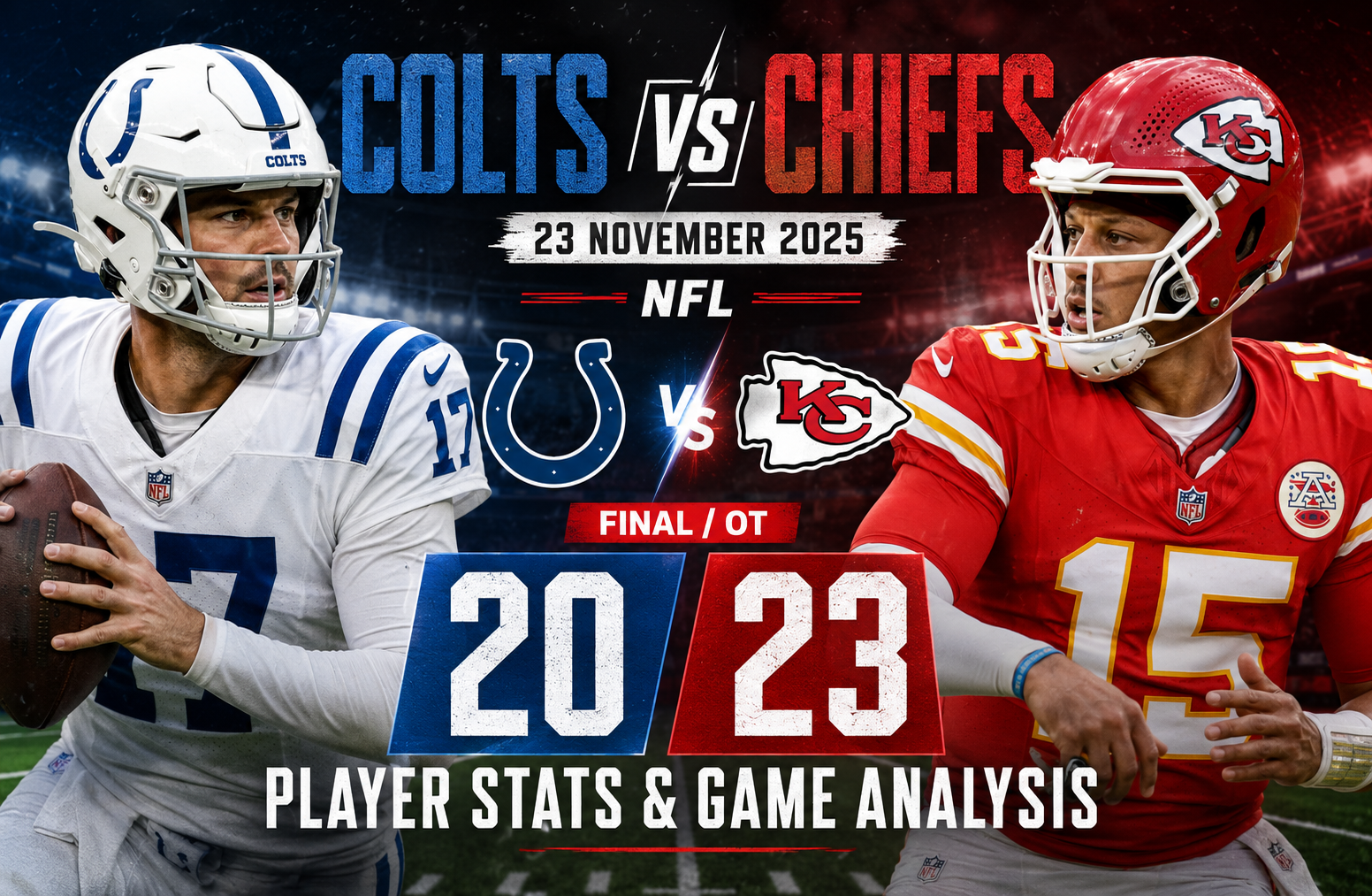
The colts vs kansas city chiefs match player stats tell the story of an intense NFL battle that was decided only after overtime. While the final score showed the Kansas City Chiefs defeating the Indianapolis Colts 23 to 20, the numbers reveal a contest filled with momentum swings, defensive resilience, standout individual performances, and a dramatic finish. Patrick Mahomes threw for more than 350 yards despite constant pressure, Daniel Jones delivered an efficient performance for Indianapolis, Harrison Butker accounted for an incredible 15 points with his flawless kicking, and Kareem Hunt carried the Chiefs’ rushing attack throughout the afternoon.
Games like this remind fans that football is rarely decided by one statistic. Passing yards, rushing efficiency, defensive pressure, field position, and special teams all contributed to the final outcome. This detailed breakdown examines every important statistical category while explaining what those numbers actually meant on the field and how they influenced the overtime victory for Kansas City.
Colts vs Kansas City Chiefs Match Player Stats: Game Overview
| Match Details | Information |
| Competition | NFL |
| Date | November 23, 2025 |
| Venue | Kansas City Chiefs Home Stadium |
| Final Score | Kansas City Chiefs 23, Indianapolis Colts 20 |
| Result | Chiefs won in Overtime |
| Colts Record | 8-3 (2-3 Away) |
| Chiefs Record | 6-5 (5-1 Home) |
At first glance, a three-point overtime victory suggests a tightly contested matchup, but the game unfolded in several distinct phases.
Indianapolis opened aggressively and built an early advantage by executing efficiently on offense. Daniel Jones avoided costly mistakes, while the Colts’ defense consistently pressured Patrick Mahomes.
Kansas City, however, gradually gained control through sustained drives rather than explosive scoring plays. Although the Chiefs failed to throw a touchdown pass, they consistently moved the football into scoring range, allowing Harrison Butker to keep adding points before the offense finally produced enough late-game momentum to force overtime.
One of the biggest takeaways from this matchup was how different offensive philosophies produced nearly identical results. Indianapolis relied on efficiency and finishing drives, while Kansas City emphasized ball control, field position, and patience.
Quarter by Quarter Score Breakdown
| Quarter | Colts | Chiefs |
| First Quarter | 7 | 0 |
| Second Quarter | 7 | 9 |
| Third Quarter | 6 | 0 |
| Fourth Quarter | 0 | 11 |
| Overtime | 0 | 3 |
| Final | 20 | 23 |
The opening quarter belonged entirely to Indianapolis. Their offense controlled possession while the defense limited Kansas City’s rhythm.
During the second quarter, the Chiefs responded with three scoring drives, narrowing the deficit before halftime.
The Colts appeared to regain momentum after adding six more points in the third period, but Kansas City’s defense stiffened when it mattered most.
The fourth quarter completely changed the complexion of the game. The Chiefs scored 11 unanswered points, erased the deficit, and forced overtime.
Once overtime began, Kansas City completed the comeback with a game-winning field goal to secure a 23-20 victory.
Passing Statistics Analysis
Quarterback play remained one of the biggest storylines throughout the contest.
Daniel Jones Delivered an Efficient Performance
| Statistic | Value |
| Completions/Attempts | 19/31 |
| Passing Yards | 181 |
| Completion Rate | 61.3% |
| Average | 5.8 Yards |
| Touchdowns | 2 |
| Interceptions | 0 |
| Sacks Taken | 0 |
| Passer Rating | 99.0 |
| QBR | 58.5 |
Daniel Jones may not have posted eye-catching yardage totals, but he played clean football.
His two touchdown passes came at critical moments, and perhaps more importantly, he protected the football throughout the game.
Another impressive aspect of his performance was avoiding sacks entirely despite Kansas City’s defensive talent. Quick reads and decisive throws prevented negative plays from disrupting Indianapolis’ offensive rhythm.
Rather than forcing risky passes, Jones consistently accepted shorter completions that kept drives alive.
Patrick Mahomes Produced Massive Yardage
| Statistic | Value |
| Completions/Attempts | 29/46 |
| Passing Yards | 352 |
| Completion Rate | 63.0% |
| Average | 7.7 Yards |
| Touchdowns | 0 |
| Interceptions | 1 |
| Sacks Taken | 4 |
| Passer Rating | 77.4 |
| QBR | 62.6 |
Patrick Mahomes produced one of the more unusual stat lines of his career.
Despite throwing for 352 yards, he failed to record a passing touchdown.
Instead, the Chiefs repeatedly moved into field-goal range without finishing drives through the air.
Mahomes also absorbed four sacks as Indianapolis generated consistent pressure. Those negative plays limited explosive scoring opportunities even though Kansas City’s passing offense accumulated significant yardage.
The lone interception thrown by Mahomes also prevented an important scoring opportunity.
Still, his ability to extend drives under pressure helped Kansas City dominate time of possession during critical stretches.
Rushing Performance Breakdown
Although passing dominated headlines, the ground game proved equally important.
Indianapolis Colts Rushing Statistics
| Player | Carries | Yards | Average | TD |
| Jonathan Taylor | 16 | 58 | 3.6 | 0 |
| Daniel Jones | 3 | 16 | 5.3 | 0 |
| Team Total | 19 | 74 | 3.9 | 0 |
Jonathan Taylor never completely took over the game.
Kansas City’s defensive front consistently limited explosive runs, allowing only one carry longer than 20 yards.
Without a rushing touchdown, Indianapolis became increasingly dependent on its passing attack inside the red zone.
Kansas City Chiefs Rushing Statistics
| Player | Carries | Yards | TD |
| Kareem Hunt | 30 | 104 | 1 |
| Patrick Mahomes | 4 | 30 | 0 |
| Clyde Edwards-Helaire | 5 | 8 | 0 |
| Brashard Smith | 1 | 5 | 0 |
| Travis Kelce | 1 | 1 | 0 |
| Team Total | 41 | 148 | 1 |
Kareem Hunt became the offensive workhorse.
Thirty rushing attempts demonstrated Kansas City’s commitment to controlling the pace of the game. Although his average remained modest at 3.5 yards per carry, Hunt consistently generated positive gains that kept the offense ahead of schedule.
His rushing touchdown proved especially valuable considering Kansas City finished without a passing touchdown.
Mahomes also contributed with timely scrambles that extended drives.
Overall, Kansas City’s 148 rushing yards represented one of the biggest statistical advantages of the afternoon.
Receiving Leaders Analysis
Both teams featured several productive pass catchers despite differing offensive approaches.
Indianapolis Colts Receiving Leaders
| Player | Receptions | Yards | TD |
| Tyler Warren | 5 | 45 | 0 |
| Michael Pittman Jr. | 5 | 27 | 1 |
| Ashton Dulin | 1 | 48 | 0 |
| Alec Pierce | 1 | 26 | 0 |
| Josh Downs | 2 | 10 | 0 |
| Mo Alie-Cox | 1 | 9 | 0 |
| Drew Ogletree | 2 | 8 | 1 |
| Jonathan Taylor | 2 | 8 | 0 |
Michael Pittman Jr. once again proved dependable in scoring situations, catching one touchdown despite being limited to only 27 receiving yards.
Tyler Warren quietly led the team in receptions, while Ashton Dulin’s 48-yard catch became Indianapolis’ biggest explosive play.
Drew Ogletree also made the most of limited opportunities by recording a touchdown on just two receptions.
Collectively, the Colts emphasized efficiency rather than volume.
Kansas City Chiefs Receiving Leaders
| Player | Receptions | Yards |
| Rashee Rice | 8 | 141 |
| Xavier Worthy | 4 | 59 |
| Travis Kelce | 4 | 43 |
| Brashard Smith | 3 | 31 |
| Kareem Hunt | 3 | 26 |
| Noah Gray | 3 | 25 |
| Hollywood Brown | 1 | 10 |
| Clyde Edwards-Helaire | 2 | 9 |
| JuJu Smith-Schuster | 1 | 8 |
Rashee Rice produced the most dominant receiving performance of the game.
His eight receptions for 141 yards consistently stretched Indianapolis’ secondary and provided Mahomes with a reliable target throughout the afternoon.
Xavier Worthy added another vertical threat by averaging nearly 15 yards per catch, while Travis Kelce continued moving the chains with several important intermediate receptions.
Even without a receiving touchdown, Kansas City’s passing game generated over 350 yards, demonstrating how consistently it moved the football between the twenties.
Defensive Performance Breakdown
The offensive statistics explain how both teams moved the football, but defense ultimately determined the outcome. Indianapolis consistently disrupted Patrick Mahomes with pressure, while Kansas City’s defense tightened in the fourth quarter and overtime to complete the comeback.
Indianapolis Colts Defensive Leaders
| Player | Tackles | Solo | Sacks | TFL | PD | INT |
| Germaine Pratt | 20 | 15 | 0 | 2 | 1 | 0 |
| Zaire Franklin | 14 | 7 | 0 | 1 | 0 | 0 |
| Nick Cross | 8 | 5 | 0 | 0 | 0 | 0 |
| Sauce Gardner | 7 | 7 | 0 | 0 | 1 | 0 |
| Kwity Paye | 6 | 2 | 1 | 0 | 0 | 0 |
| Grover Stewart | 6 | 1 | 0.5 | 0 | 0 | 0 |
| Laiatu Latu | 5 | 2 | 0.5 | 0 | 0 | 1 |
Team Defensive Totals
| Category | Total |
| Total Tackles | 100 |
| Solo Tackles | 58 |
| Sacks | 4 |
| Tackles for Loss | 4 |
| Passes Defended | 5 |
| QB Hits | 11 |
Indianapolis produced one of its strongest defensive performances of the season despite the defeat.
Germaine Pratt dominated the middle of the field with an outstanding 20 tackles. His ability to diagnose running plays prevented Kansas City from creating explosive rushing gains, even though Kareem Hunt eventually surpassed 100 rushing yards through volume.
Zaire Franklin added another 14 tackles, giving the Colts two linebackers who consistently cleaned up plays before they turned into significant gains.
Perhaps the most impressive aspect of Indianapolis’ defense was its pass rush. Four sacks and eleven quarterback hits kept Patrick Mahomes under constant pressure. While Mahomes still accumulated 352 passing yards, very few throws came comfortably from a clean pocket.
Laiatu Latu also recorded the game’s only interception, creating one of the biggest defensive highlights of the afternoon.
Kansas City Chiefs Defensive Leaders
| Player | Tackles | Solo | TFL | PD |
| Bryan Cook | 8 | 5 | 1 | 1 |
| Nick Bolton | 8 | 2 | 0 | 1 |
| Chris Roland-Wallace | 7 | 4 | 0 | 1 |
| Leo Chenal | 6 | 3 | 0 | 1 |
| Trent McDuffie | 5 | 5 | 0 | 1 |
| Drue Tranquill | 3 | 3 | 2 | 0 |
| Jaden Hicks | 3 | 3 | 0 | 1 |
Team Defensive Totals
| Category | Total |
| Total Tackles | 58 |
| Solo Tackles | 35 |
| Sacks | 0 |
| Tackles for Loss | 4 |
| Passes Defended | 6 |
| QB Hits | 6 |
Kansas City’s defense delivered a different type of performance.
Unlike Indianapolis, the Chiefs failed to register a sack, largely because Daniel Jones released the football quickly throughout the game.
Instead, Kansas City’s defense focused on limiting explosive plays after the catch and forcing Indianapolis to sustain long drives. That strategy became increasingly effective during the fourth quarter, when the Colts were held scoreless despite entering the period with a lead.
Bryan Cook and Nick Bolton led the tackling effort, while Trent McDuffie once again demonstrated why he remains one of the NFL’s most reliable defensive backs.
Special Teams Made the Difference
Close NFL games are often decided by special teams, and this matchup perfectly illustrated that reality.
Kicking Statistics
| Player | Field Goals | Long | Extra Points | Total Points |
| Michael Badgley | 2/2 | 32 | 2/2 | 8 |
| Harrison Butker | 5/5 | 48 | 0/0 | 15 |
No individual influenced the final score more than Harrison Butker.
Converting all five field-goal attempts gave Kansas City 15 points, accounting for nearly two-thirds of the team’s total offense on the scoreboard.
Without Butker’s consistency, the Chiefs would not have reached overtime.
Michael Badgley also enjoyed a flawless afternoon, but his opportunities were fewer because Indianapolis converted two touchdowns rather than settling for field goals.
Punting Battle
| Player | Punts | Average | Inside 20 | Long |
| Rigoberto Sanchez | 6 | 49.0 | 5 | 59 |
| Matt Araiza | 3 | 49.0 | 0 | 50 |
Rigoberto Sanchez quietly produced an outstanding performance.
Five punts pinned Kansas City inside its own 20-yard line, consistently forcing the Chiefs to drive long distances.
Matt Araiza matched Sanchez’s average distance but had fewer opportunities because Kansas City’s offense maintained possession for longer stretches.
Kick Return Statistics
Indianapolis Colts
| Player | Returns | Yards | Average |
| Ameer Abdullah | 4 | 106 | 26.5 |
| Ashton Dulin | 1 | 40 | 40.0 |
| Anthony Gould | 1 | 26 | 26.0 |
Team Total: 172 return yards
Kansas City Chiefs
| Player | Returns | Yards | Average |
| Nikko Remigio | 3 | 68 | 22.7 |
| Tyquan Thornton | 2 | 47 | 23.5 |
Team Total: 115 return yards
Indianapolis clearly won the field-position battle through kick returns.
Ameer Abdullah consistently gave the Colts favorable starting field position, while Ashton Dulin’s 40-yard return provided another momentum-changing play.
Punt Returns
| Team | Player | Returns | Yards | Average |
| Colts | Anthony Gould | 3 | 49 | 16.3 |
| Chiefs | Nikko Remigio | 4 | 7 | 1.8 |
Anthony Gould created valuable hidden yardage throughout the game, averaging more than 16 yards per punt return.
Kansas City’s coverage unit limited significant returns for most of the afternoon, but Indianapolis still gained a noticeable advantage in this phase.
Ball Security
Turnovers frequently determine close games.
| Team | Fumbles Lost | Interceptions Thrown |
| Indianapolis Colts | 0 | 0 |
| Kansas City Chiefs | 1 | 1 |
Kansas City committed both turnovers in the game.
Patrick Mahomes threw one interception, while Kareem Hunt lost a fumble.
Despite losing the turnover battle, the Chiefs still secured the victory because they dominated rushing attempts, generated more total offensive yards, and converted scoring opportunities through Harrison Butker’s perfect kicking performance.
Key Turning Points
Several moments shifted momentum toward Kansas City.
Harrison Butker’s Perfect Afternoon
Every field-goal attempt mattered. His five successful kicks ensured the Chiefs remained within striking distance throughout regulation before delivering the overtime winner.
Rashee Rice Took Control
Rice finished with 141 receiving yards and repeatedly created explosive gains that moved Kansas City’s offense into scoring range.
Kareem Hunt’s Heavy Workload
Thirty rushing attempts gradually wore down the Colts’ defense and helped Kansas City control the pace late in the game.
Indianapolis Could Not Score in the Fourth Quarter
The Colts entered the final quarter with the lead but failed to produce another point. Kansas City’s defense made crucial adjustments exactly when they were needed most.
Overtime Execution
Once the game entered overtime, Kansas City maintained its composure, drove into scoring position, and completed the comeback with the decisive field goal.
Complete Team Comparison
The statistics show that both teams excelled in different phases of the game. Indianapolis played a disciplined and efficient brand of football, while Kansas City generated more total offense and eventually wore down the Colts over four quarters and overtime.
| Category | Indianapolis Colts | Kansas City Chiefs |
| Final Score | 20 | 23 |
| Passing Yards | 181 | 352 |
| Passing TDs | 2 | 0 |
| Interceptions Thrown | 0 | 1 |
| Rushing Yards | 74 | 148 |
| Rushing TDs | 0 | 1 |
| Total First Downs Through Offense | More efficient scoring | Sustained long drives |
| Sacks Recorded | 4 | 0 |
| Field Goals Made | 2 | 5 |
| Turnovers Lost | 0 | 2 |
| Overtime Result | Lost | Won |
One of the most unusual aspects of this game was how Kansas City won despite losing the turnover battle and failing to throw a touchdown pass. Normally, teams that commit two turnovers and record zero passing touchdowns struggle to secure a victory.
Instead, the Chiefs compensated by controlling possession, doubling Indianapolis’ rushing production, and relying on outstanding special teams play. Their offense consistently moved into scoring range even when drives stalled inside the red zone.
Indianapolis deserves credit for playing one of its most disciplined games of the season. Daniel Jones protected the football, the offensive line surrendered no sacks, and the defense pressured Patrick Mahomes throughout the contest. However, failing to score during the fourth quarter ultimately proved costly.
Player Grades
Based on the statistical impact and influence on the outcome, the following grades reflect each player’s overall performance in this matchup.
Indianapolis Colts
| Player | Grade | Analysis |
| Daniel Jones | A | Efficient, protected the football, threw two touchdowns, avoided sacks. |
| Jonathan Taylor | B | Worked hard but found little running room against Kansas City’s front. |
| Michael Pittman Jr. | B+ | Reliable red-zone target with one touchdown reception. |
| Tyler Warren | B+ | Led the team in receptions and contributed consistently. |
| Ashton Dulin | B | Produced the Colts’ longest reception of the game. |
| Germaine Pratt | A+ | Outstanding defensive performance with 20 tackles. |
| Zaire Franklin | A | Constant presence around the football all afternoon. |
| Laiatu Latu | A | Generated pressure and intercepted Patrick Mahomes. |
| Kwity Paye | B+ | Registered an important sack and several pressures. |
Kansas City Chiefs
| Player | Grade | Analysis |
| Patrick Mahomes | B+ | Massive passing yardage despite heavy pressure and no passing touchdowns. |
| Kareem Hunt | A | Workhorse performance with 104 rushing yards and the team’s only touchdown. |
| Rashee Rice | A+ | Dominated the receiving game with 141 yards. |
| Xavier Worthy | B+ | Created explosive plays that stretched the defense. |
| Travis Kelce | B | Continued moving the chains with key receptions. |
| Harrison Butker | A+ | Perfect kicking performance and the biggest reason Kansas City won. |
| Bryan Cook | B+ | Led the defensive backfield in tackles. |
| Nick Bolton | B+ | Solid tackling performance throughout the game. |
What the Numbers Really Tell Us
Looking beyond the box score reveals why Kansas City escaped with an overtime victory.
The Chiefs accumulated significantly more offensive yardage than Indianapolis, but they struggled to finish drives with touchdowns. Normally, a team producing over 350 passing yards would be expected to score multiple touchdowns through the air. Instead, Indianapolis consistently forced Kansas City to settle for field goals.
On the opposite side, the Colts were remarkably efficient inside scoring territory. Daniel Jones threw two touchdown passes despite finishing with only 181 passing yards.
This contrast highlights an important football principle. Efficiency often outweighs volume. Indianapolis maximized its opportunities, while Kansas City created far more opportunities overall.
Eventually, sustained offensive pressure favored the Chiefs.
Overtime rewarded the team that controlled possession for longer stretches throughout the afternoon.
Biggest Winners From the Game
Several players significantly improved their standing with performances that extended beyond traditional statistics.
Rashee Rice
Rice looked every bit like a true number-one receiver. His route running, separation, and ability to create explosive gains repeatedly challenged Indianapolis’ secondary.
Harrison Butker
Scoring 15 points without missing a kick demonstrates why dependable special teams remain invaluable in close NFL games.
Kareem Hunt
His workload reflected complete trust from the coaching staff. Thirty carries in today’s NFL is uncommon, making his performance even more impressive.
Germaine Pratt
Although Indianapolis lost, Pratt produced one of the best defensive statistical performances of the week with 20 tackles.
Areas Each Team Can Improve
Indianapolis Colts
The Colts should be encouraged by their defensive effort and disciplined quarterback play. However, they will want to improve several areas moving forward.
- Generate more explosive rushing plays.
- Finish games stronger during the fourth quarter.
- Sustain offensive drives after building a lead.
- Convert defensive pressure into additional turnovers.
Kansas City Chiefs
Despite earning the victory, Kansas City also has room for improvement.
- Convert long drives into touchdowns instead of field goals.
- Protect the football more effectively.
- Reduce sacks allowed on Patrick Mahomes.
- Improve red-zone execution.
Frequently Asked Questions
Who won the Colts vs Chiefs game on November 23, 2025?
The Kansas City Chiefs defeated the Indianapolis Colts 23-20 in overtime after completing a fourth-quarter comeback.
Who led all passers in the game?
Patrick Mahomes led all quarterbacks with 352 passing yards on 29 completions, while Daniel Jones finished with 181 yards and two touchdown passes.
Which running back had the best rushing performance?
Kareem Hunt led all rushers with 104 yards on 30 carries and scored the Chiefs’ only rushing touchdown.
Who recorded the most receiving yards?
Rashee Rice finished with a game-high 141 receiving yards on eight receptions.
Which defensive player recorded the most tackles?
Germaine Pratt led all defenders with an outstanding 20 tackles, including 15 solo stops.
Why did Kansas City win despite committing more turnovers?
The Chiefs controlled the ground game with 148 rushing yards, accumulated significantly more passing yards, and received a perfect five-for-five kicking performance from Harrison Butker, allowing them to overcome two costly turnovers.
Conclusion
The colts vs kansas city chiefs match player stats reveal far more than a simple 23-20 overtime scoreline. Indianapolis executed an efficient offensive game plan, protected the football, and consistently pressured Patrick Mahomes, yet Kansas City’s persistence ultimately proved decisive.
Patrick Mahomes’ 352 passing yards highlighted the Chiefs’ ability to move the football even under heavy pressure, while Kareem Hunt’s physical running attack balanced the offense during crucial moments. Rashee Rice emerged as the game’s premier receiver with 141 yards, and Harrison Butker delivered a flawless kicking performance that accounted for 15 points, including the game-winning field goal in overtime.
For Indianapolis, Daniel Jones managed the offense effectively, Germaine Pratt anchored a relentless defensive effort with 20 tackles, and Laiatu Latu’s interception demonstrated the Colts’ defensive playmaking ability. Despite those positives, the inability to score in the fourth quarter allowed Kansas City to erase the deficit and eventually secure the victory.
When evaluating this matchup, the statistics reinforce an important lesson. Total yardage creates opportunities, but execution in critical moments determines outcomes. Kansas City capitalized on those moments better than Indianapolis, turning sustained offensive pressure and dependable special teams into an overtime victory that strengthened its home record.