Dallas Cowboys vs Denver Broncos Match Player Stats
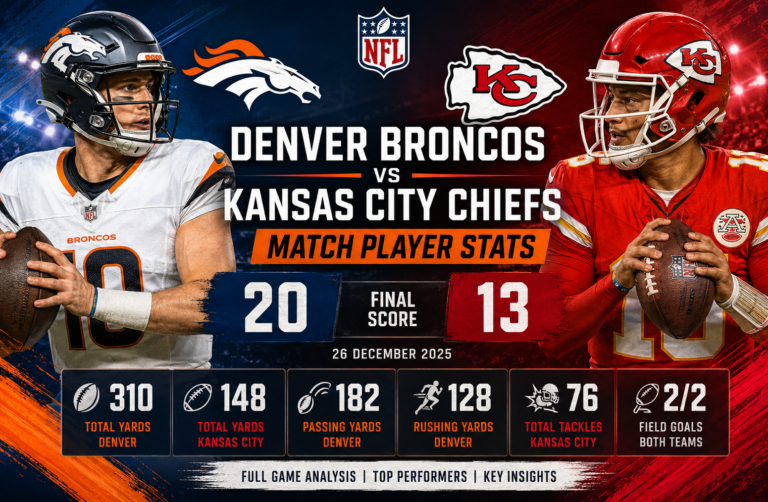
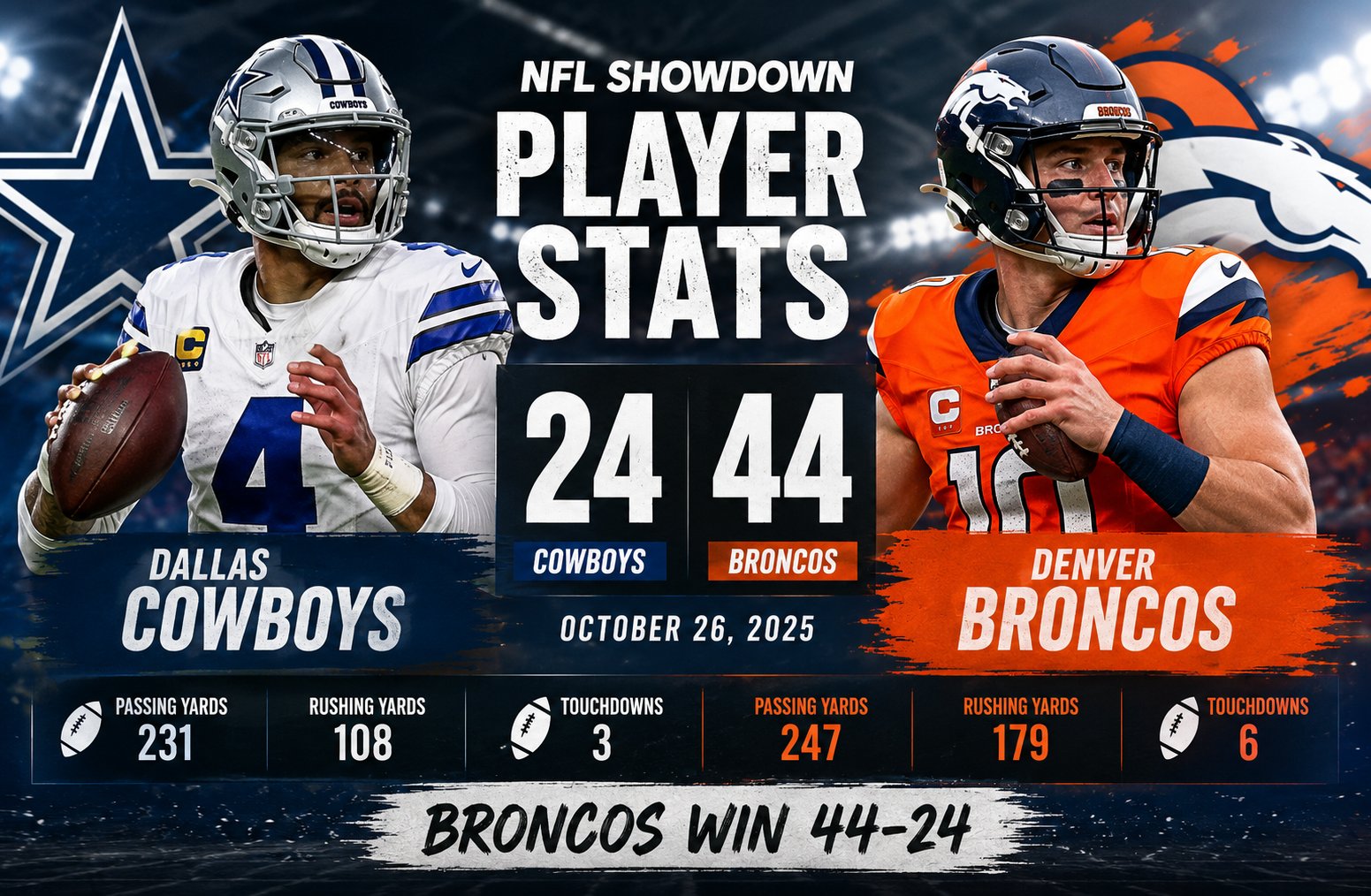
The dallas cowboys vs denver broncos match player stats tell the complete story of how the Denver Broncos secured an impressive 44 to 24 victory over the Dallas Cowboys on October 26, 2025. While the final score highlights Denver’s dominance, the player statistics reveal exactly why the Broncos controlled the game from start to finish. Bo Nix delivered one of his most efficient performances of the season with four touchdown passes, Denver’s rushing attack consistently moved the chains, and the defense forced critical turnovers that shifted momentum. On the other side, Dallas struggled to establish offensive rhythm despite flashes of production from George Pickens, CeeDee Lamb, and backup quarterback Joe Milton III. This detailed breakdown examines every major statistic, key performance, and decisive moment that shaped the outcome.
Match Overview
| Match Detail | Information |
| Event | Denver Broncos vs Dallas Cowboys |
| Date | October 26, 2025 |
| Competition | NFL |
| Venue | Broncos Home |
| Final Score | Denver Broncos 44, Dallas Cowboys 24 |
| Broncos Record | 6-2 (4-0 Home) |
| Cowboys Record | 3-4-1 (1-4 Away) |
Playing at home, Denver entered the matchup with confidence and protected its unbeaten home record in convincing fashion. The Broncos were sharper in every phase of the game, including offense, defense, and special teams.
Dallas had opportunities to remain competitive early, but costly turnovers, limited rushing production, and an inability to slow Bo Nix ultimately proved too much to overcome.
Dallas Cowboys vs Denver Broncos Match Player Stats Summary
The dallas cowboys vs denver broncos match player stats highlight a significant difference in offensive efficiency.
Team Offensive Comparison
| Category | Cowboys | Broncos |
| Total Passing Yards | 231 | 247 |
| Passing TDs | 1 | 4 |
| Interceptions Thrown | 2 | 1 |
| Rushing Yards | 108 | 179 |
| Rushing TDs | 2 | 2 |
| Total Points | 24 | 44 |
Although passing yards were relatively close, Denver converted drives into touchdowns far more consistently. The Broncos also dominated on the ground with 179 rushing yards, keeping Dallas’ defense under constant pressure.
Quarter by Quarter Breakdown
First Quarter
The Broncos immediately established momentum.
Dallas Cowboys: 3 points
Denver Broncos: 14 points
Denver’s offense attacked aggressively from the opening drive, while Dallas managed only a field goal from Brandon Aubrey.
Second Quarter
The Broncos extended their lead with another productive offensive quarter.
Dallas Cowboys: 7 points
Denver Broncos: 13 points
Bo Nix continued finding open receivers, and Denver entered halftime firmly in control.
Third Quarter
Dallas briefly showed signs of life.
Dallas Cowboys: 7 points
Denver Broncos: 3 points
The Cowboys managed one of their better offensive stretches, but Denver’s defense prevented any significant comeback.
Fourth Quarter
Denver closed the game in dominant fashion.
Dallas Cowboys: 7 points
Denver Broncos: 14 points
The Broncos finished strong, adding two more touchdowns while maintaining control throughout the closing minutes.
Passing Performance Analysis
Quarterback play became one of the biggest differences in the contest.
Dallas Cowboys Passing
Dak Prescott
Dak Prescott completed:
- 19 completions
- 31 attempts
- 188 passing yards
- 0 passing touchdowns
- 2 interceptions
Prescott struggled to push the ball downfield consistently and was forced into difficult throws as Denver’s defense tightened coverage.
Joe Milton III
Joe Milton III entered later in the game and produced an encouraging performance.
His numbers included:
- 3 completions
- 4 attempts
- 58 yards
- 1 touchdown
- 0 interceptions
Although his appearance came after the game had largely been decided, Milton displayed confidence and accuracy.
Broncos Passing
Bo Nix
Bo Nix delivered one of the most efficient quarterback performances of the week.
He finished with:
- 19 completions
- 29 attempts
- 247 passing yards
- 4 touchdown passes
- 1 interception
Rather than relying on one receiver, Nix distributed the football effectively across multiple targets and consistently made quick decisions under pressure.
His four touchdown passes represented the biggest statistical difference between both offenses.
Why Denver Won the Passing Battle
The raw yardage alone does not explain the outcome.
Denver finished with only 16 more passing yards than Dallas, yet produced:
- Four passing touchdowns
- Better red-zone execution
- Higher scoring efficiency
- Fewer wasted possessions
- Better protection throughout the game
The Cowboys accumulated respectable yardage but failed to convert drives into touchdowns, allowing Denver to steadily build its lead.
Rushing Performance Analysis
One of the biggest reasons Denver controlled this game was its success on the ground. While the passing numbers between both teams were relatively close, the rushing attack created a clear separation. Denver consistently gained positive yardage on early downs, controlled the clock, and kept Dallas’ defense on the field for extended drives.
Dallas Cowboys Rushing Stats
The Cowboys finished with:
| Team Rushing Stats | Total |
| Carries | 31 |
| Rushing Yards | 108 |
| Rushing Touchdowns | 2 |
Although Dallas reached the end zone twice on the ground, the overall production lacked explosiveness. Most rushing attempts resulted in short gains, making it difficult to sustain long drives.
Javonte Williams
Javonte Williams led the Cowboys’ rushing effort with a determined performance.
His numbers included:
- 13 carries
- 41 rushing yards
- 2 rushing touchdowns
Williams made the most of his opportunities near the goal line, accounting for both rushing scores. However, his average gain per carry reflected how effectively Denver’s defensive front limited big running plays throughout the afternoon.
Dak Prescott
Prescott also contributed with his legs when passing lanes closed.
He recorded:
- 6 carries
- 31 rushing yards
Several of those runs came on scrambles rather than designed quarterback runs. While they helped extend a few drives, they were not enough to change the momentum of the game.
Denver Broncos Rushing Stats
Denver’s ground game was one of the most complete performances of the season.
| Team Rushing Stats | Total |
| Carries | 28 |
| Rushing Yards | 179 |
| Rushing Touchdowns | 2 |
The Broncos averaged significantly more yards per attempt and consistently put themselves in manageable second and third downs. This balance also created more opportunities for Bo Nix to attack through play action.
J.K. Dobbins
J.K. Dobbins delivered an outstanding rushing performance and provided the foundation for Denver’s offense.
He finished with:
- 15 carries
- 111 rushing yards
Dobbins repeatedly broke through the first level of the Cowboys’ defense and generated several explosive runs that shifted field position. Crossing the 100 yard mark highlighted just how effective Denver’s offensive line was in creating running lanes.
RJ Harvey
RJ Harvey complemented Dobbins perfectly.
His final statistics included:
- 7 carries
- 46 rushing yards
- 2 rushing touchdowns
Harvey’s role became especially important inside the red zone, where he converted scoring opportunities into touchdowns and helped Denver maintain its lead.
Comparing the Ground Game
The rushing statistics reveal why Denver maintained control throughout most of the contest.
| Category | Cowboys | Broncos |
| Carries | 31 | 28 |
| Rushing Yards | 108 | 179 |
| Rushing Touchdowns | 2 | 2 |
| Leading Rusher | Javonte Williams (41) | J.K. Dobbins (111) |
Even though Dallas had more rushing attempts, Denver gained substantially more yards. That efficiency allowed the Broncos to dictate the pace and keep their offense ahead of the chains.
The ability to consistently gain first downs on the ground also reduced pressure on Bo Nix, allowing him to throw in favorable situations.
Receiving Performance Breakdown
The receiving units for both teams produced solid yardage, but Denver turned receptions into touchdowns far more effectively.
Dallas Cowboys Receiving Stats
The Cowboys finished with:
| Team Receiving Stats | Total |
| Receptions | 22 |
| Receiving Yards | 246 |
| Receiving Touchdowns | 1 |
Several receivers contributed, but explosive scoring plays were limited.
George Pickens
George Pickens led Dallas in receiving.
His production included:
- 7 receptions
- 78 receiving yards
Pickens consistently created separation and made several difficult catches in traffic. He served as Prescott’s most reliable target during much of the game.
CeeDee Lamb
CeeDee Lamb remained heavily involved.
He recorded:
- 7 receptions
- 74 receiving yards
Lamb moved the chains on several occasions but was prevented from making the type of game changing play that could have shifted momentum.
Jalen Tolbert
Tolbert made his biggest impact in the red zone.
His final numbers:
- 2 receptions
- 47 receiving yards
- 1 touchdown
His touchdown reception accounted for Dallas’ only passing score of the afternoon.
Denver Broncos Receiving Stats
Denver’s receiving corps made the most of every scoring opportunity.
| Team Receiving Stats | Total |
| Receptions | 19 |
| Receiving Yards | 247 |
| Receiving Touchdowns | 4 |
Despite catching fewer passes than Dallas, Denver generated four receiving touchdowns through outstanding execution inside the red zone.
Troy Franklin
Troy Franklin emerged as the game’s most productive receiver.
He finished with:
- 6 receptions
- 89 receiving yards
- 2 touchdowns
Franklin consistently found open space against the Cowboys’ secondary and became Bo Nix’s preferred target during critical situations.
Courtland Sutton
Courtland Sutton continued to demonstrate why he remains one of Denver’s most dependable playmakers.
His statistics included:
- 4 receptions
- 67 receiving yards
Although Sutton did not score, his catches helped extend multiple scoring drives.
Pat Bryant
Pat Bryant contributed an important receiving touchdown that further widened Denver’s advantage.
RJ Harvey
Already productive as a runner, Harvey added another dimension by catching a touchdown pass, giving him three total touchdowns in the game.
Receiving Comparison
Looking strictly at receiving yardage, the teams appeared evenly matched.
| Category | Cowboys | Broncos |
| Receptions | 22 | 19 |
| Receiving Yards | 246 | 247 |
| Receiving TDs | 1 | 4 |
This comparison demonstrates that total yardage alone rarely determines an NFL game.
Denver converted opportunities into points, while Dallas often settled for shorter gains without finishing drives.
Offensive Efficiency Made the Difference
The dallas cowboys vs denver broncos match player stats show that offensive efficiency mattered more than total production.
Dallas accumulated respectable passing and receiving numbers, but Denver excelled in the moments that decide football games:
- Better red zone execution
- Four touchdown passes from Bo Nix
- A 179 yard rushing performance
- Balanced offensive production
- Fewer costly mistakes
- Consistent scoring throughout all four quarters
Rather than relying on one standout player, the Broncos received meaningful contributions from multiple offensive playmakers. That balance made the offense difficult to defend and allowed Denver to maintain control from the opening quarter until the final whistle.
Defensive Performance Analysis
While Denver’s offense deserved much of the attention after scoring 44 points, the defensive unit quietly played one of its most disciplined games of the season. The Broncos forced turnovers, pressured the quarterback at key moments, and limited Dallas whenever the Cowboys attempted to build momentum.
Dallas also produced several solid defensive plays, but the inability to create consistent pressure or force enough negative plays allowed Denver’s balanced offense to remain in control.
Dallas Cowboys Defensive Statistics
The Cowboys’ defense recorded the following team totals:
| Category | Total |
| Total Tackles | 62 |
| Solo Tackles | 33 |
| Sacks | 0 |
| Tackles for Loss | 3 |
| Passes Defended | 2 |
| Quarterback Hits | 1 |
These numbers illustrate one of Dallas’ biggest challenges throughout the game. Despite making tackles after completions and runs, the defense rarely disrupted Denver’s offensive rhythm behind the line of scrimmage.
Kenneth Murray Jr.
Kenneth Murray Jr. led the Cowboys defensively with:
- 7 total tackles
He remained active throughout the contest and frequently stopped running plays before they turned into larger gains. However, he received limited support when Denver successfully spread the field.
Trikweze Bridges
Bridges provided one of Dallas’ defensive highlights.
His performance included:
- 1 interception
- 7 interception return yards
The interception briefly gave the Cowboys an opportunity to shift momentum, but the offense was unable to fully capitalize.
Denver Broncos Defensive Statistics
Denver’s defense delivered one of its most complete performances of the season.
| Category | Total |
| Total Tackles | 81 |
| Solo Tackles | 31 |
| Sacks | 2 |
| Tackles for Loss | 3 |
| Passes Defended | 12 |
| Quarterback Hits | 8 |
The Broncos consistently pressured Dallas quarterbacks, contested passing lanes, and forced difficult decisions throughout the afternoon.
Alex Singleton
Alex Singleton anchored the defensive effort.
He finished with:
- 11 total tackles
Singleton was consistently around the football, limiting rushing gains while also contributing in pass coverage.
Dondrea Tillman
Tillman made one of the biggest defensive plays of the game.
His statistics included:
- 1 interception
- 36 interception return yards
The return gave Denver excellent field position and helped maintain offensive momentum.
Jahdae Barron
Barron also contributed with:
- 1 interception
His takeaway ended another promising Dallas drive and reinforced Denver’s control of the contest.
Turnovers Played a Major Role
One of the clearest statistical differences came in the turnover battle.
| Turnover Category | Cowboys | Broncos |
| Interceptions Thrown | 2 | 1 |
| Interceptions Made | 1 | 2 |
| Team Fumbles | 1 Recovered | None |
Dallas managed to recover its own fumble, avoiding another costly mistake. However, the two interceptions thrown by Prescott proved far more damaging.
Denver protected the football well, committing only one interception and avoiding any fumbles. That ball security prevented Dallas from gaining the extra possessions needed to mount a comeback.
Special Teams Performance
Special teams often receive less attention than offense and defense, but this matchup featured several strong individual performances.
Cowboys Special Teams
Brandon Aubrey
The Cowboys’ kicker remained dependable.
His statistics:
- 1 field goal made
- Longest field goal: 24 yards
- 3 extra points made
- 6 total points
Aubrey converted every scoring opportunity presented to him.
Bryan Anger
Dallas punter Bryan Anger handled a heavy workload.
He recorded:
- 5 punts
- 252 total punt yards
- 50.4 yard average
- Longest punt: 58 yards
His strong leg consistently helped improve field position despite Denver’s offensive success.
KaVontae Turpin
Turpin continued to be an explosive return specialist.
His numbers:
- 3 kick returns
- 86 return yards
- 28.7 yard average
Although he produced quality field position, Dallas struggled to convert those opportunities into enough points.
Broncos Special Teams
Denver’s special teams unit matched the quality shown by its offense and defense.
Wil Lutz
Lutz delivered another efficient performance.
He finished with:
- 1 field goal made
- Longest field goal: 42 yards
- 5 extra points made
- 8 total points
Every scoring drive concluded successfully, maximizing Denver’s offensive production.
Jeremy Crawshaw
The Broncos required only two punts because of their offensive efficiency.
His statistics:
- 2 punts
- 80 total yards
- 40.0 yard average
- Longest punt: 47 yards
Marvin Mims Jr.
Mims provided valuable production in the return game.
Kick returns:
- 3 returns
- 93 yards
- 31.0 yard average
Team kick return total:
- 4 returns
- 119 yards
- 29.8 yard average
Punt returns:
- 2 returns
- 26 yards
His consistency helped Denver begin several drives with favorable field position.
Five Key Moments That Decided the Game
Every NFL game includes defining moments, and this matchup was no exception.
1. Denver’s Fast Start
Scoring 14 points in the opening quarter immediately placed pressure on Dallas. Playing from behind forced the Cowboys away from a balanced offensive approach.
2. Bo Nix’s Four Touchdown Passes
Nix consistently found open receivers and finished drives with touchdowns rather than field goals. That efficiency separated the two offenses.
3. Denver’s Dominant Running Game
The Broncos accumulated 179 rushing yards compared to Dallas’ 108. Sustaining long drives kept Denver’s defense rested while limiting Dallas’ offensive possessions.
4. Two Defensive Interceptions
The Broncos converted defensive pressure into takeaways, giving their offense additional opportunities and preventing the Cowboys from building momentum.
5. Red Zone Execution
Denver consistently finished drives with touchdowns. Dallas often moved the football effectively but could not match that scoring efficiency.
Individual Performances That Stood Out
Several players significantly influenced the outcome through their individual production.
Bo Nix
The Broncos quarterback demonstrated poise, accuracy, and excellent decision making throughout the contest. Completing 19 of 29 passes for 247 yards and four touchdowns showcased his ability to lead an efficient offense.
J.K. Dobbins
Surpassing 100 rushing yards gave Denver offensive balance and prevented Dallas from focusing exclusively on defending the passing game.
Troy Franklin
Franklin’s six receptions, 89 receiving yards, and two touchdowns made him the most dangerous receiving threat on the field.
Alex Singleton
Leading all defenders with 11 tackles reflected his impact against both the run and the pass.
George Pickens
Despite the loss, Pickens remained Dallas’ most productive receiver, consistently creating separation and finishing with 78 receiving yards.
Joe Milton III
Although his playing time was limited, Milton’s touchdown pass and efficient completion rate provided one positive takeaway for Dallas heading into future games.
Team Comparison
The overall numbers explain why Denver earned a convincing victory.
| Category | Cowboys | Broncos |
| Points | 24 | 44 |
| Passing Yards | 231 | 247 |
| Passing TDs | 1 | 4 |
| Rushing Yards | 108 | 179 |
| Rushing TDs | 2 | 2 |
| Interceptions Thrown | 2 | 1 |
| Defensive Interceptions | 1 | 2 |
| Sacks | 0 | 2 |
| QB Hits | 1 | 8 |
These statistics reveal a simple pattern. Denver performed better in nearly every category that directly influences winning football games, including turnovers, quarterback pressure, rushing production, and touchdown efficiency.
The dallas cowboys vs denver broncos match player stats demonstrate that while Dallas generated respectable offensive yardage, Denver consistently made the more impactful plays. Explosive offense, disciplined defense, and reliable special teams combined to produce one of the Broncos’ most complete victories of the 2025 season.
Complete Team Statistics
The numbers from this matchup provide a clear picture of how Denver outperformed Dallas in critical areas. While total passing yards were relatively close, the Broncos converted their opportunities into touchdowns, controlled the running game, and protected the football more effectively.
Offensive Team Statistics
| Category | Dallas Cowboys | Denver Broncos |
| Final Score | 24 | 44 |
| Passing Yards | 231 | 247 |
| Passing Touchdowns | 1 | 4 |
| Passing Interceptions | 2 | 1 |
| Rushing Attempts | 31 | 28 |
| Rushing Yards | 108 | 179 |
| Rushing Touchdowns | 2 | 2 |
| Receptions | 22 | 19 |
| Receiving Yards | 246 | 247 |
| Receiving Touchdowns | 1 | 4 |
Defensive Team Statistics
| Category | Dallas Cowboys | Denver Broncos |
| Total Tackles | 62 | 81 |
| Solo Tackles | 33 | 31 |
| Sacks | 0 | 2 |
| Tackles for Loss | 3 | 3 |
| Passes Defended | 2 | 12 |
| Quarterback Hits | 1 | 8 |
| Interceptions | 1 | 2 |
What the Statistics Really Tell Us
Looking beyond the box score, this game was decided by efficiency rather than total yardage. Dallas finished with respectable offensive production, but Denver consistently made bigger plays when it mattered most.
The Broncos demonstrated balance throughout the contest. Bo Nix delivered an efficient passing performance without forcing unnecessary throws, while J.K. Dobbins and RJ Harvey established a rushing attack that kept the Cowboys’ defense guessing. This combination prevented Dallas from focusing on any single offensive threat.
Defensively, Denver excelled in creating pressure. Recording two sacks, eight quarterback hits, and two interceptions disrupted Dallas’ offensive rhythm from start to finish. The secondary also played one of its strongest games, breaking up 12 passes and limiting explosive completions.
Dallas showed moments of promise, particularly through George Pickens, CeeDee Lamb, and Joe Milton III late in the game. However, the Cowboys struggled to finish drives consistently and were unable to overcome the early deficit created by Denver’s explosive first half.
One area that deserves particular attention is the rushing battle. Denver finished with 179 rushing yards compared to Dallas’ 108, allowing the Broncos to control possession and maintain offensive balance. Winning the ground game also reduced pressure on Bo Nix, enabling him to take calculated shots downfield.
The turnover margin further emphasized Denver’s discipline. The Broncos avoided costly mistakes while forcing two interceptions that directly influenced field position and momentum.
For readers interested in official NFL records and historical statistics, the NFL Stats database provides comprehensive team and player data throughout the season.
Frequently Asked Questions
What was the final score between the Dallas Cowboys and Denver Broncos?
The Denver Broncos defeated the Dallas Cowboys 44 to 24 on October 26, 2025, at the Broncos’ home stadium.
Who had the best performance in the game?
Bo Nix delivered one of the game’s best performances by completing 19 of 29 passes for 247 yards, four touchdowns, and one interception. His efficiency played a major role in Denver’s victory.
Who led the rushing attack?
J.K. Dobbins led all rushers with 111 yards on 15 carries. RJ Harvey added 46 rushing yards and scored two rushing touchdowns for Denver.
Which Cowboys receiver had the most receiving yards?
George Pickens led Dallas with seven receptions for 78 receiving yards, narrowly finishing ahead of CeeDee Lamb, who recorded seven catches for 74 yards.
How many interceptions were thrown in the game?
There were three interceptions in total. Dallas quarterbacks threw two interceptions, while Bo Nix threw one.
Why did the Broncos win this matchup?
Denver won because of superior offensive efficiency, a dominant rushing attack, four touchdown passes from Bo Nix, strong defensive pressure, and two timely interceptions that limited Dallas’ scoring opportunities.
Conclusion
The dallas cowboys vs denver broncos match player stats reveal far more than a 44 to 24 final score. They illustrate a game in which Denver executed its game plan with remarkable consistency across every phase. Bo Nix efficiently directed the passing attack, the Broncos’ rushing game controlled the tempo, and the defense consistently disrupted Dallas’ offense through pressure and takeaways.
For the Cowboys, individual performances from George Pickens, CeeDee Lamb, Javonte Williams, and Joe Milton III offered encouraging moments, but the team could not overcome early mistakes or match Denver’s scoring efficiency. The Broncos capitalized on nearly every opportunity, demonstrating why they improved to a 6-2 record while remaining undefeated at home.
Ultimately, this matchup serves as an excellent example of how balanced offense, disciplined defense, and efficient execution often outweigh similar total yardage in determining the outcome of an NFL game.