Chicago Bears vs Bengals Match Player Stats
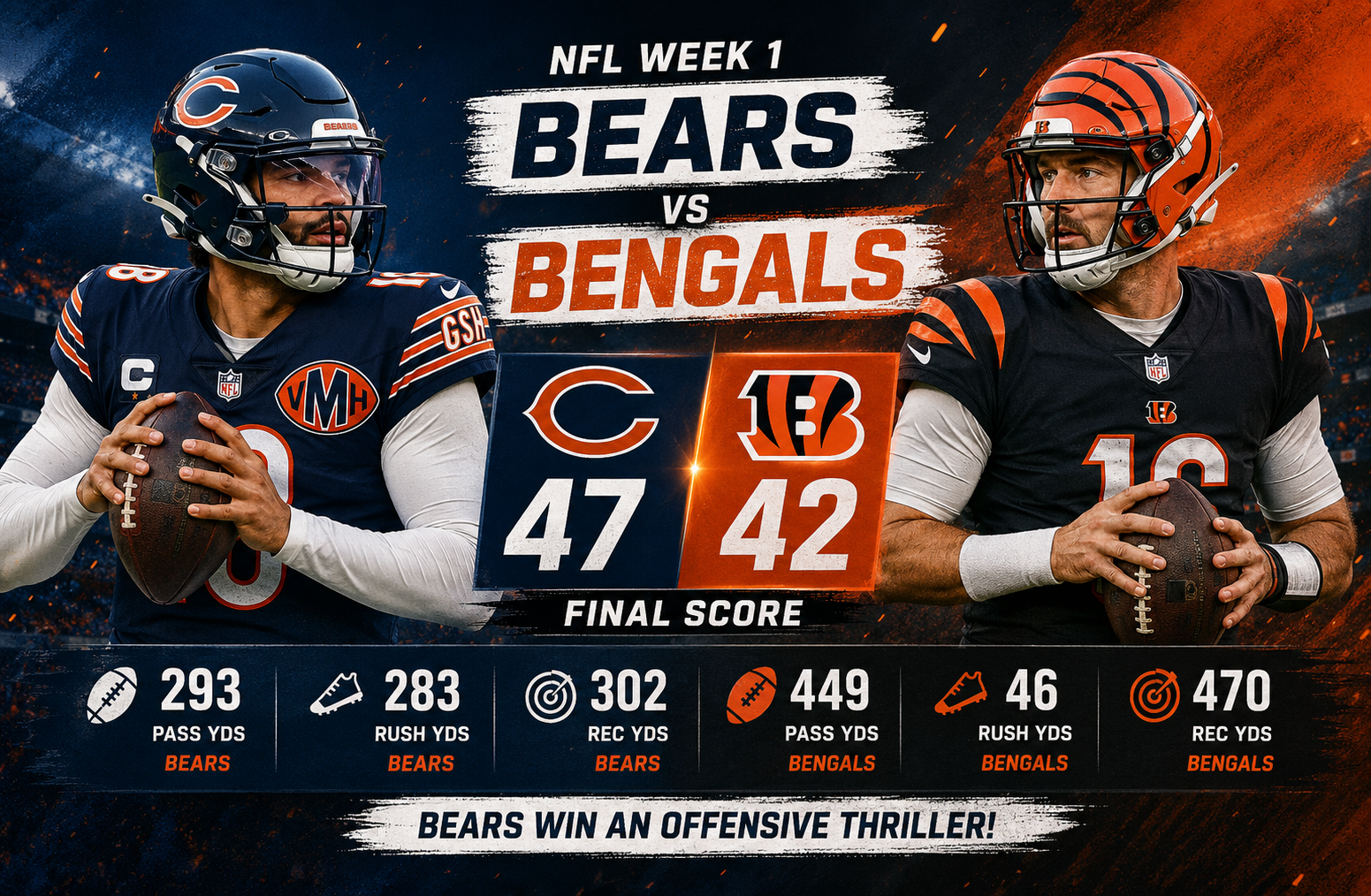
The Chicago bears vs bengals match player stats tell the story of one of the most entertaining NFL contests of the 2025 season. Played on November 2, 2025, this Week 1 matchup delivered an offensive showcase that featured explosive passing plays, dominant rushing from Chicago, and dramatic momentum swings from the opening kickoff until the final whistle. Although Cincinnati produced more passing yards, the Bears combined an efficient aerial attack with a relentless ground game to secure an exciting 47 to 42 victory.
Fans searching for chicago bears vs bengals match player stats are usually looking beyond the final score. They want to know which players shaped the outcome, how each offense performed, which defensive plays changed the momentum, and what the numbers reveal about both teams moving forward. This article examines every major statistical category using the official box score while providing context that helps explain why Chicago emerged victorious in one of the highest scoring games of the season.
Match Overview
| Match Details | Information |
| Event | Chicago Bears vs Cincinnati Bengals |
| League | NFL |
| Week | Week 1 |
| Date | November 2, 2025 |
| Venue | NFL Regular Season |
| Final Score | Chicago Bears 47, Cincinnati Bengals 42 |
| Winning Team | Chicago Bears |
A five point margin may suggest a close contest, but the game itself featured several momentum swings. Chicago consistently answered Cincinnati’s scoring drives with efficient offensive possessions, while timely defensive takeaways ultimately proved to be the difference.
The Bears improved their season record to 5 and 3, while the Bengals dropped to 3 and 6 despite one of their strongest passing performances of the year.
Chicago Bears vs Bengals Match Player Stats: Final Score Breakdown
| Team | Q1 | Q2 | Q3 | Q4 | Total |
| Chicago Bears | 7 | 10 | 14 | 16 | 47 |
| Cincinnati Bengals | 10 | 10 | 7 | 15 | 42 |
Chicago finished stronger during the second half by scoring 30 points after halftime, demonstrating excellent offensive adjustments and consistent execution when the game mattered most.
First Half Analysis
Cincinnati opened aggressively, putting together productive drives that allowed them to take an early advantage. Joe Flacco found his receivers consistently, while Tee Higgins and Ja’Marr Chase created separation against the Bears secondary.
Chicago, however, remained composed. Caleb Williams answered with efficient drives of his own, avoiding turnovers and keeping the offense balanced through both the air and on the ground.
At halftime, the game remained completely open, with neither defense capable of consistently slowing the opposing offense.
Third Quarter Momentum Shift
The third quarter proved decisive.
Chicago’s offensive line began dominating the line of scrimmage, allowing Kyle Monangai to consistently gain significant yardage on early downs.
That success created favorable passing situations for Caleb Williams, who capitalized with accurate throws to Colston Loveland and DJ Moore.
Meanwhile, Chicago’s defense forced mistakes that Cincinnati could not fully overcome.
Fourth Quarter Shootout
The final quarter featured sixteen Bears points and fifteen Bengals points.
Joe Flacco continued attacking downfield, but Chicago answered nearly every scoring drive with one of its own. Instead of becoming conservative, the Bears continued attacking through both the running and passing game.
Their balanced offensive strategy ultimately secured the victory despite Cincinnati’s late comeback attempt.
Offensive Performance Comparison
One of the biggest stories from this matchup was the contrast in offensive styles.
Chicago relied on offensive balance.
Cincinnati relied heavily on the passing game.
Although both approaches produced impressive scoring totals, Chicago’s ability to control possession through its rushing attack created more sustainable drives.
| Offensive Category | Bears | Bengals |
| Total Points | 47 | 42 |
| Passing Yards | 293 | 449 |
| Passing TD | 4 | 4 |
| Rushing Yards | 283 | 46 |
| Rushing TD | 2 | 0 |
| Turnovers Lost | 0 | 3 |
The turnover column deserves particular attention.
Chicago protected the football throughout the game.
Cincinnati committed costly mistakes that ultimately outweighed its impressive passing production.
Passing Statistics Analysis
Passing numbers were outstanding for both teams.
Caleb Williams Performance
Chicago’s young quarterback delivered one of his most efficient games of the season.
| Statistic | Caleb Williams |
| Completions | 20 |
| Attempts | 34 |
| Passing Yards | 280 |
| Passing TD | 3 |
| Interceptions | 0 |
Williams consistently made smart decisions, avoided unnecessary risks, and allowed his playmakers to gain yards after the catch.
Perhaps most importantly, he finished without throwing an interception.
That clean performance became one of the biggest reasons Chicago won despite Cincinnati’s explosive offense.
Joe Flacco Performance
Joe Flacco produced remarkable passing yardage despite the loss.
| Statistic | Joe Flacco |
| Completions | 31 |
| Attempts | 47 |
| Passing Yards | 470 |
| Passing TD | 4 |
| Interceptions | 2 |
From a statistical standpoint, 470 passing yards ranks among the best individual performances of the season.
However, two interceptions reduced the overall impact of those numbers.
While Flacco repeatedly stretched the field, Chicago’s defense capitalized on its limited opportunities to force turnovers.
Team Passing Comparison
| Category | Bears | Bengals |
| Completions | 22 | 31 |
| Attempts | 37 | 47 |
| Passing Yards | 293 | 449 |
| Passing TD | 4 | 4 |
| Interceptions Thrown | 0 | 2 |
| Passer Rating | 121.7 | Lower due to turnovers |
The statistics highlight an interesting contrast.
Cincinnati generated significantly more passing yards.
Chicago generated greater passing efficiency.
Efficiency often proves more valuable than raw production, especially when turnovers become part of the equation.
In this matchup, that principle clearly held true.
Rushing Statistics Analysis
While much of the attention naturally falls on the quarterbacks, the rushing battle ultimately separated the two teams. Chicago established the run early and never abandoned it, allowing the offense to stay balanced throughout all four quarters. Cincinnati, on the other hand, struggled to generate consistent production on the ground, becoming increasingly dependent on the passing game.
The contrast in rushing efficiency explains why Chicago controlled several crucial drives, especially in the second half.
Team Rushing Comparison
| Category | Chicago Bears | Cincinnati Bengals |
| Carries | 37 | 15 |
| Rushing Yards | 283 | 46 |
| Average Per Carry | 7.6 | 3.1 |
| Rushing Touchdowns | 2 | 0 |
A difference of 237 rushing yards is enormous in any NFL game. Chicago consistently won at the line of scrimmage, creating running lanes that allowed the offense to stay ahead of schedule.
The Bengals rarely found similar success, forcing Joe Flacco to shoulder most of the offensive workload.
Kyle Monangai Dominated the Ground Game
Kyle Monangai delivered one of the best rushing performances of the game.
| Statistic | Kyle Monangai |
| Carries | 26 |
| Rushing Yards | 176 |
| Average Per Carry | 6.8 |
Every successful rushing attempt helped Chicago control the clock while reducing pressure on Caleb Williams.
Rather than relying on explosive passing plays every possession, the Bears repeatedly gained positive yardage on first and second down. That offensive balance created manageable third downs and extended drives.
Chase Brown Could Not Find Running Room
The Bengals entered the game hoping to establish offensive balance, but Chicago’s defensive front prevented that from happening.
| Statistic | Chase Brown |
| Carries | 11 |
| Rushing Yards | 37 |
Without a productive rushing attack, Cincinnati became predictable. The Bears adjusted accordingly, focusing defensive attention on defending the pass during key situations.
Receiving Statistics Analysis
Both teams featured outstanding receiving performances. Cincinnati accumulated more receiving yards overall, but Chicago converted key receptions into touchdowns and sustained drives.
Chicago Bears Receiving Leaders
| Player | Receptions | Yards | Touchdowns |
| Colston Loveland | 6 | 118 | 2 |
| DJ Moore | 4 | 72 | 0 |
Colston Loveland emerged as Caleb Williams’ favorite target.
His ability to create separation and finish drives inside the red zone made him one of the game’s most impactful offensive players.
DJ Moore complemented that production by stretching the field and moving the chains during several important possessions.
Cincinnati Bengals Receiving Leaders
| Player | Receptions | Yards | Touchdowns |
| Tee Higgins | 7 | 121 | 2 |
| Ja’Marr Chase | 6 | 111 | 0 |
Tee Higgins showcased excellent route running throughout the contest, finishing with over 120 receiving yards and two touchdowns.
Ja’Marr Chase continued to demonstrate why he remains one of the NFL’s premier receivers, consistently creating explosive plays and keeping the Bengals within striking distance.
Team Receiving Comparison
| Category | Bears | Bengals |
| Receptions | 22 | 31 |
| Receiving Yards | 302 | 470 |
| Receiving Touchdowns | 4 | 4 |
Although Cincinnati accumulated significantly more receiving yards, Chicago generated points with greater efficiency.
That difference proved more valuable than total yardage.
Defensive Performance Breakdown
High scoring games often overshadow defensive contributions, but several defensive plays directly influenced the final result.
Chicago’s defense recorded the game’s most important takeaways.
Bears Defensive Highlights
- 66 total tackles
- 3 sacks
- 2 interceptions
- 0 lost fumbles on offense
The interceptions by Nahshon Wright and Tremaine Edmunds changed the momentum at critical moments.
Rather than simply limiting yardage, Chicago’s defense created extra possessions for an already productive offense.
Bengals Defensive Performance
Cincinnati’s defense worked hard throughout the afternoon but struggled to contain Chicago’s balanced attack.
Defensive totals included:
- 85 total tackles
- 2 sacks
- No interceptions forced
Recording 85 tackles often indicates a defense spent significant time on the field. Chicago’s sustained offensive drives forced Cincinnati’s defenders into extended action, particularly during the second half.
Turnovers Changed the Outcome
One statistic stands above nearly every other category.
| Turnover Category | Bears | Bengals |
| Interceptions Thrown | 0 | 2 |
| Fumbles Lost | 0 | 1 |
Chicago finished with zero turnovers.
Cincinnati committed three total turnovers.
Despite producing more passing yards, the Bengals repeatedly gave away valuable possessions.
Winning the turnover battle by three is usually enough to determine the outcome of an NFL game, and this contest followed that pattern.
Special Teams Performance
Special teams quietly played an important role throughout the matchup.
Chicago Bears
Cairo Santos
| Category | Performance |
| Field Goals | 2 of 3 |
| Extra Points | 5 of 5 |
| Total Points | 11 |
Santos converted key kicks that helped maintain Chicago’s lead during the second half.
Tory Taylor
| Category | Performance |
| Punts | 2 |
| Total Yards | 117 |
| Average | 58.5 |
Taylor’s limited workload reflected Chicago’s offensive efficiency.
Cincinnati Bengals
Evan McPherson
| Category | Performance |
| Field Goals | 2 of 3 |
| Extra Points | 4 of 4 |
| Total Points | 10 |
McPherson remained dependable despite the loss.
Ryan Rehkow
| Category | Performance |
| Punts | 1 |
| Average | 53.0 |
The Bengals rarely punted because their offense consistently moved the football.
Kick Return Comparison
Special teams produced one of the game’s most exciting moments.
| Category | Bears | Bengals |
| Returns | 6 | 8 |
| Return Yards | 134 | 297 |
| Average | 22.3 | 37.1 |
| Return Touchdowns | 0 | 1 |
Charlie Jones electrified the crowd with a spectacular 98 yard kickoff return touchdown, finishing with 179 return yards on four returns.
Although that explosive play gave Cincinnati valuable points, Chicago’s offense responded effectively and prevented the momentum from lasting.
Why Chicago Won Despite Fewer Passing Yards
Looking only at passing statistics could suggest Cincinnati controlled the game.
The complete picture tells a different story.
Chicago won because it excelled in the areas that often decide close NFL games:
- Protected the football.
- Dominated the rushing attack.
- Converted offensive opportunities into touchdowns.
- Forced timely turnovers.
- Controlled the pace during critical possessions.
- Balanced passing and rushing throughout all four quarters.
These strengths outweighed Cincinnati’s advantage in passing yardage.
Statistical Leaders
Chicago Bears
| Category | Leader | Performance |
| Passing | Caleb Williams | 280 yards, 3 TD |
| Rushing | Kyle Monangai | 176 yards |
| Receiving | Colston Loveland | 118 yards, 2 TD |
| Defensive Play | Nahshon Wright | 1 INT |
| Defensive Play | Tremaine Edmunds | 1 INT |
Cincinnati Bengals
| Category | Leader | Performance |
| Passing | Joe Flacco | 470 yards, 4 TD |
| Rushing | Chase Brown | 37 yards |
| Receiving | Tee Higgins | 121 yards, 2 TD |
| Big Play | Charlie Jones | 98 yard kickoff return TD |
Key Takeaways from the Match
The chicago bears vs bengals match player stats reveal much more than a thrilling 47 to 42 scoreline. They show how efficiency, balance, and disciplined football can outweigh raw offensive production.
Several trends stand out after reviewing the complete box score.
Chicago’s Balanced Offense Made the Difference
Chicago finished with fewer passing yards than Cincinnati, yet the offense remained more effective because it attacked in multiple ways. Caleb Williams distributed the football efficiently, while Kyle Monangai consistently moved the chains on the ground.
That combination prevented the Bengals from focusing on a single aspect of the Bears offense.
Turnovers Changed the Momentum
Winning the turnover battle often decides close NFL games.
Chicago committed no turnovers while forcing three from Cincinnati. Those extra possessions proved invaluable in a game decided by only five points.
Dominant Rushing Performance
A rushing advantage of 283 yards to 46 cannot be overlooked.
The Bears controlled the tempo, extended drives, and reduced pressure on their passing attack by consistently winning at the line of scrimmage.
Explosive Passing Kept Cincinnati Competitive
Despite the loss, Joe Flacco delivered an outstanding statistical performance.
Throwing for 470 yards and four touchdowns demonstrates how dangerous Cincinnati’s passing offense can be when given opportunities.
Likewise, Tee Higgins and Ja’Marr Chase repeatedly created explosive plays that kept the Bengals within striking distance until the final whistle.
Complete Team Statistics
| Category | Chicago Bears | Cincinnati Bengals |
| Final Score | 47 | 42 |
| Passing Yards | 293 | 449 |
| Passing TD | 4 | 4 |
| Rushing Yards | 283 | 46 |
| Rushing TD | 2 | 0 |
| Total Receiving Yards | 302 | 470 |
| Interceptions Thrown | 0 | 2 |
| Fumbles Lost | 0 | 1 |
| Sacks | 3 | 2 |
| Total Tackles | 66 | 85 |
| Kick Return Yards | 134 | 297 |
These numbers summarize why the game remained competitive from start to finish while also highlighting the areas that ultimately favored Chicago.
What This Game Means for Both Teams
For Chicago, this victory demonstrated the value of offensive balance. Caleb Williams showed excellent decision making, the offensive line created consistent rushing lanes, and the defense generated timely takeaways.
For Cincinnati, the passing game remains a significant strength. Joe Flacco, Tee Higgins, and Ja’Marr Chase combined for one of the league’s most productive aerial performances. However, reducing turnovers and improving rushing efficiency will be essential in future matchups.
The game also reinforced an important lesson that applies across the NFL. Total yardage alone rarely determines the winner. Ball security, situational execution, and complementary football often carry greater importance than a single statistical category.
Frequently Asked Questions
Who won the Chicago Bears vs Cincinnati Bengals game?
The Chicago Bears defeated the Cincinnati Bengals by a final score of 47 to 42 on November 2, 2025.
Who threw the most passing yards in the game?
Joe Flacco led all quarterbacks with 470 passing yards, completing 31 of 47 passes with four touchdowns and two interceptions.
Who was the leading rusher?
Kyle Monangai led all rushers with 176 rushing yards on 26 carries, helping Chicago dominate the ground game.
Which receiver had the most receiving yards?
Tee Higgins finished with 121 receiving yards and two touchdowns, narrowly edging Colston Loveland, who recorded 118 receiving yards.
Why did the Bears win despite fewer passing yards?
Chicago protected the football, rushed for 283 yards, forced three turnovers, and maintained better offensive balance throughout the game.
Conclusion
The chicago bears vs bengals match player stats illustrate why this contest will be remembered as one of the most entertaining offensive performances of the 2025 NFL season. Chicago combined efficient quarterback play, dominant rushing, and opportunistic defense to earn a 47 to 42 victory despite facing one of the most productive passing attacks of the year.
Caleb Williams delivered an efficient, mistake free performance, Kyle Monangai controlled the game on the ground, and Colston Loveland emerged as a dependable receiving target. On the opposite side, Joe Flacco, Tee Higgins, and Ja’Marr Chase produced remarkable passing numbers, but three costly turnovers prevented Cincinnati from converting outstanding individual performances into a win.
For anyone analyzing this matchup, the statistics provide a clear lesson. Offensive balance, protecting possession, and capitalizing on defensive opportunities remain the foundation of winning football, even in games filled with explosive scoring and impressive individual achievements.