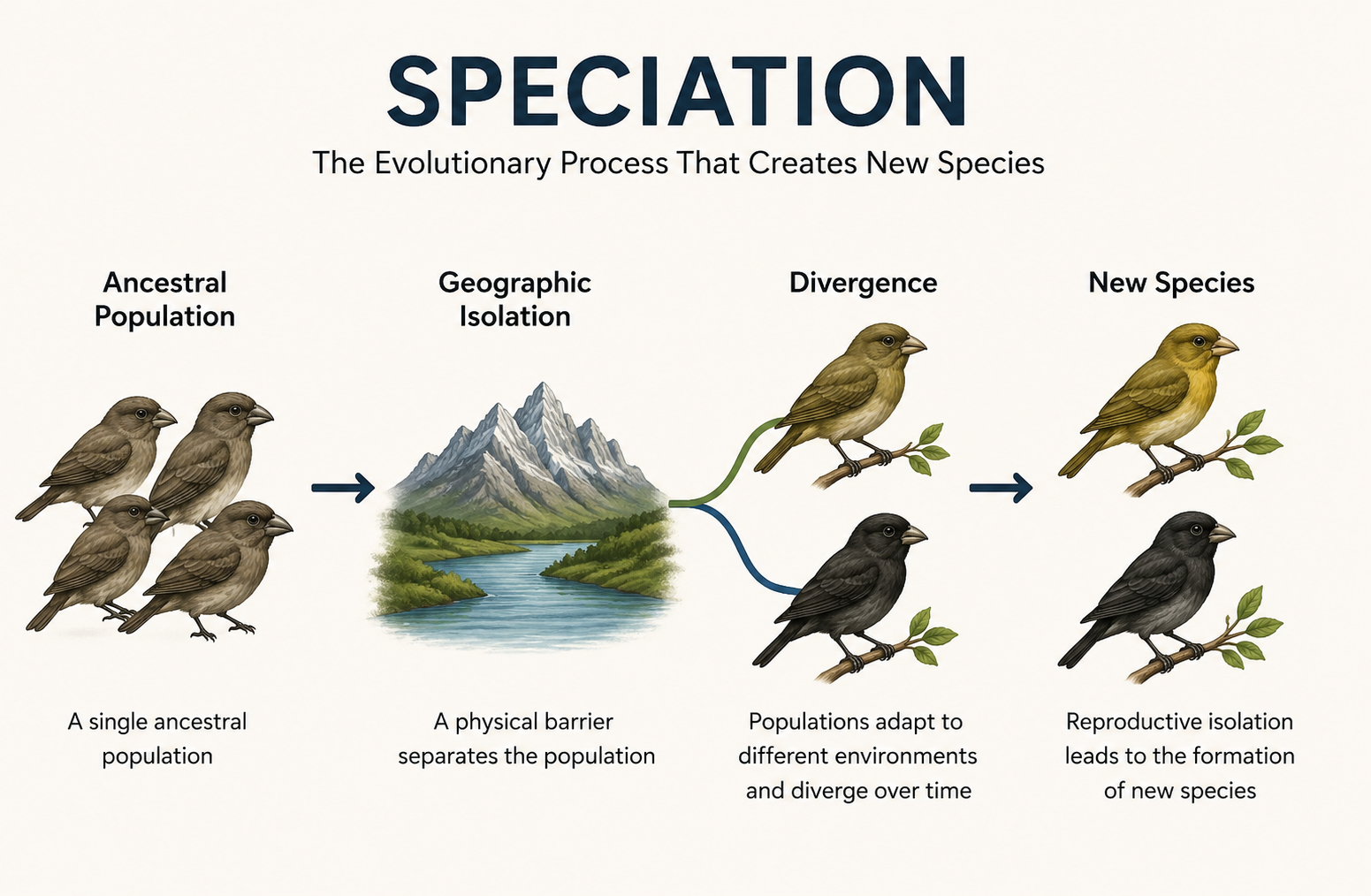
Speciering: How New Species Evolve Naturally
Speciation is one of the most fascinating processes in biology because it explains how life on Earth becomes more diverse over time. Although your target keyword is speciering, the scientific concept behind it is speciation, the evolutionary process through which populations gradually develop into distinct species. If you searched for speciering, you are likely looking for an explanation of how new species form, why populations become different, and what mechanisms drive this remarkable process. Understanding speciation helps explain everything from Darwin’s famous observations on islands to modern discoveries about genetics, adaptation, and biodiversity.
Scientists have spent more than a century studying how new species originate. Their research shows that no single pathway explains every case. Instead, different evolutionary forces work together over long periods. Natural selection, reproductive isolation, genetic variation, sexual selection, and environmental changes all contribute to the development of new species. Some forms of speciation occur gradually across thousands of generations, while others can happen surprisingly quickly under specific conditions, particularly in plants.
This guide explores the science behind speciation using established biological knowledge, historical discoveries, and modern evolutionary research. Whether you are a student, educator, or simply curious about evolution, this article provides a complete and easy to understand explanation.
What Is Speciation?
Speciation is the evolutionary process through which populations evolve into separate species. The term was introduced by Orator F. Cook in 1906 to describe cladogenesis, which refers to the splitting of one evolutionary lineage into two or more distinct lineages.
Unlike gradual evolutionary change within a single species, known as anagenesis, speciation creates entirely new species that can no longer successfully reproduce with one another.
At its core, speciation depends on one critical principle.
Reproductive isolation.
When populations stop exchanging genes over many generations, they begin accumulating genetic differences. Eventually, these differences become significant enough that members of one population can no longer produce fertile offspring with members of another. At this point, scientists recognize them as separate species.
This concept remains one of the most widely accepted explanations for how biological diversity develops across the planet.
Why Speciation Matters
Every ecosystem on Earth contains an extraordinary variety of living organisms. Understanding how that diversity emerged helps scientists answer important questions about evolution, conservation, ecology, and genetics.
Speciation matters because it helps explain:
- The origin of Earth’s millions of species
- Why closely related organisms sometimes look very different
- How populations adapt to changing environments
- Why endangered populations may require separate conservation strategies
- How biodiversity continues to develop today
Without speciation, evolution would simply produce gradual changes within existing species instead of generating entirely new forms of life.
Historical Development of the Concept
The scientific understanding of speciation developed gradually through decades of research.
Charles Darwin provided the first major explanation in On the Origin of Species, published in 1859. Darwin argued that natural selection allows populations to adapt to different environments over time. Although genetics was not yet understood, Darwin recognized that populations could gradually diverge until they became distinct species.
One question puzzled Darwin throughout his work.
If evolution occurs continuously, why do clearly separated species exist instead of countless intermediate forms?
This became known as Darwin’s dilemma.
Modern evolutionary biology offers a strong explanation.
Reproductive isolation prevents continuous mixing between diverging populations. Once populations stop exchanging genes, they continue evolving independently. Sexual reproduction reinforces these differences because individuals usually mate within their own population.
Today, reproductive isolation remains one of the central concepts in evolutionary biology.
Primary Forces Driving Speciation
Scientists now recognize several evolutionary mechanisms that contribute to the formation of new species.
Natural Selection
Natural selection remains the primary mechanism behind most documented cases of speciation.
Individuals possessing traits that improve survival or reproduction leave more offspring. Over many generations, these beneficial traits become increasingly common.
If two populations experience different environmental conditions, natural selection favors different adaptations in each population. Eventually, these differences accumulate until reproductive isolation develops.
Natural selection explains many famous examples, including Darwin’s finches, whose beak shapes evolved according to different food sources on the Galápagos Islands.
Sexual Selection
Not all evolutionary change results directly from survival.
Sometimes individuals choose mates based on appearance, behavior, or courtship displays.
This process, known as sexual selection, can gradually separate populations if mating preferences become increasingly different.
Research has shown that mate choice alone may eventually produce reproductive isolation, making sexual selection an important contributor to speciation.
Reproductive Isolation
Among all proposed mechanisms, reproductive isolation is considered the defining feature separating species.
Isolation may develop because of:
- Geographic barriers
- Behavioral differences
- Genetic incompatibilities
- Different breeding seasons
- Ecological specialization
Once gene flow becomes limited or stops entirely, independent evolution begins.
Why Gene Flow Is Important
Gene flow refers to the movement of genes between populations through reproduction.
As long as individuals from different populations continue breeding successfully, genetic differences remain relatively small.
When gene flow decreases, populations begin accumulating unique mutations and adaptations.
Eventually these changes become large enough that reproduction between populations becomes difficult or impossible.
Scientists often describe this process using the idea of species barriers, which are genetic differences reducing successful reproduction between diverging populations.
The Cost of Rarity
An interesting concept in evolutionary biology is the cost of rarity.
Rare populations often struggle to find suitable mates.
Because of this disadvantage, uncommon groups may disappear before becoming established species.
This helps explain why many small populations become extinct while only a few survive long enough to continue diverging.
The idea also supports the importance of reproductive isolation in maintaining distinct species.
Koinophilia and Stable Species
Another concept that helps explain stable species is koinophilia.
Koinophilia refers to the tendency for individuals to prefer mates with common characteristics rather than unusual ones.
When most individuals choose partners that resemble the majority of the population, unusual traits spread more slowly.
This preference naturally reinforces reproductive isolation and helps preserve distinct species over long periods.
Asexual Reproduction and Species Formation
Species boundaries become much more difficult to define in organisms that reproduce without sex.
Unlike sexually reproducing organisms, asexual populations do not experience the same reproductive barriers.
Continuous genetic variation often develops without clearly separated lineages.
As a result, scientists generally find it more challenging to classify species among asexual organisms.
Types of Speciation
Speciering Through Geographic Isolation
One of the most common questions people searching for speciering ask is whether physical separation is necessary for new species to form.
The answer is no.
Although geographic isolation explains many well known examples, scientists recognize several different pathways.
The four major geographic modes include:
- Allopatric speciation
- Peripatric speciation
- Parapatric speciation
- Sympatric speciation
Each follows a different evolutionary pathway while ultimately producing reproductive isolation.
Allopatric Speciation
Allopatric speciation occurs when populations become physically separated by geographical barriers such as:
- Mountains
- Rivers
- Oceans
- Deserts
- Glaciers
Once separated, each population experiences different environmental pressures, mutations, and natural selection.
Over many generations, they accumulate enough differences to become separate species.
One of the best known examples involves Darwin’s finches on the Galápagos Islands, where isolated island populations evolved different beak shapes and feeding strategies.
Another classic example includes the diversification of three spined stickleback populations after the last glacial period. Marine ancestors colonized freshwater habitats, where isolated populations gradually evolved into distinct freshwater species.
Peripatric Speciation
Peripatric speciation is closely related to allopatric speciation, but it begins with a much smaller population.
Instead of a large group becoming divided into two equally sized populations, a small number of individuals become isolated at the edge of the original population’s range. Because the new population contains only a fraction of the original genetic diversity, evolutionary change can occur more rapidly.
Scientists believe two important processes often work together during peripatric speciation:
- Natural selection
- Genetic drift
The isolated population experiences different environmental conditions while random genetic changes may have a greater impact because the population is small. This combination can accelerate divergence and eventually produce reproductive isolation.
Although genetic drift is often discussed in connection with peripatric speciation, evolutionary biologists continue to study exactly how much influence it has compared with natural selection.
Parapatric Speciation
Parapatric speciation occurs when neighboring populations occupy different environments while maintaining limited contact.
Unlike allopatric speciation, there is no complete geographic barrier separating the populations. Instead, individuals may occasionally interbreed, allowing a small amount of gene flow.
Despite this limited exchange of genes, different environmental pressures gradually favor different adaptations.
For example, one population may become adapted to:
- Dry habitats
- High elevations
- Different soil conditions
- Distinct food sources
- Unique climates
Meanwhile, a nearby population adapts to another environment.
Over time, the differences become large enough that successful reproduction becomes increasingly difficult.
Parapatric speciation demonstrates that complete physical separation is not always necessary for new species to evolve.
Sympatric Speciation
Sympatric speciation is perhaps the most surprising form of species formation because it occurs without geographic separation.
Members of the same population continue living in the same region but gradually become reproductively isolated.
Several biological processes may contribute to sympatric speciation, including:
- Different feeding preferences
- Mate choice
- Ecological specialization
- Polyploidy in plants
- Behavioral differences
Scientists once questioned whether sympatric speciation was truly possible. Today, research has provided convincing evidence that it occurs under certain conditions.
Examples include:
- East African cichlid fishes
- Hawthorn flies (Rhagoletis pomonella)
- Tennessee cave salamanders
- Lake Baikal crustaceans
These examples show that populations sharing the same geographic area can still evolve into separate species.
Ecological Speciation
Ecological speciation focuses on adaptation to different environments rather than simple geographic distance.
When populations begin exploiting different ecological resources, natural selection favors different traits.
Examples include differences in:
- Diet
- Habitat
- Temperature tolerance
- Predator avoidance
- Feeding behavior
As adaptations become stronger, reproductive isolation gradually develops.
Ecological speciation highlights how environmental diversity helps generate biological diversity.
Natural Selection and Environmental Adaptation
Natural selection remains the driving force behind many documented examples of speciation.
Environmental pressures constantly influence which traits increase survival and reproduction.
These pressures may include:
- Climate
- Food availability
- Competition
- Disease
- Predators
- Habitat structure
Even relatively small environmental differences can accumulate over thousands of generations.
Eventually, populations become genetically distinct enough that they no longer interbreed successfully.
This gradual process explains why Earth’s biodiversity continues changing over evolutionary time.
The Role of Sexual Selection
Sexual selection differs from natural selection because it focuses on reproductive success rather than survival.
Individuals often choose mates based on characteristics such as:
- Color
- Songs
- Courtship displays
- Size
- Behavioral signals
If different populations begin preferring different traits, mating between populations becomes less common.
Eventually, these preferences themselves become barriers to reproduction.
Modern evolutionary biology recognizes sexual selection as an important contributor to reproductive isolation.
Understanding Genetic Drift
Genetic drift refers to random changes in gene frequencies.
Unlike natural selection, genetic drift does not necessarily improve adaptation.
Instead, chance events influence which genes become more common.
Genetic drift tends to have its strongest effects in:
- Small populations
- Founder populations
- Isolated groups
Scientists continue investigating exactly how much genetic drift contributes to speciation.
Current evidence suggests that while genetic drift may accelerate divergence in some situations, natural selection remains the primary mechanism behind most well documented cases.
Polyploidy and Rapid Species Formation
Most animals inherit two complete sets of chromosomes.
Plants, however, sometimes experience genome duplication.
This process is known as polyploidy.
Polyploid individuals often become reproductively isolated from their parent population almost immediately because chromosome numbers no longer match during reproduction.
For this reason, polyploidy represents one of the fastest known mechanisms of speciation.
It has played a major role in the evolution of flowering plants and continues to influence plant diversity today.
Hybrid Speciation
Hybridization occurs when individuals from different species successfully reproduce.
Although hybrids are often less fertile, this is not always the end of the story.
In some cases, hybrids become reproductively isolated from both parent species.
If they establish stable populations, an entirely new species may emerge.
This process is called hybrid speciation.
Researchers have documented hybrid speciation in several plant groups and some animal lineages, demonstrating that hybridization can contribute to biodiversity rather than simply producing evolutionary dead ends.
Reinforcement
Sometimes populations begin diverging but still produce hybrid offspring.
If those hybrids have lower survival or reproductive success, natural selection favors individuals that avoid mating with members of the other population.
This process is called reinforcement.
It strengthens reproductive isolation by reducing unsuccessful hybridization.
Reinforcement is also known as the Wallace Effect.
Rather than creating reproductive barriers from scratch, reinforcement strengthens barriers that already exist.
Over time, populations become increasingly distinct until they function as separate species.
Species Barriers
Species barriers are genetic differences that reduce gene flow between diverging populations.
These barriers may occur:
- Before fertilization
- During fertilization
- After fertilization
Examples include:
- Different breeding seasons
- Behavioral incompatibility
- Mechanical incompatibility
- Reduced hybrid fertility
- Reduced hybrid survival
Scientists recognize species barriers as one of the defining characteristics separating distinct species.
The Dobzhansky Muller Model
One influential explanation for postzygotic isolation is the Dobzhansky Muller model.
According to this model, populations evolving independently accumulate different genetic changes.
Each change functions normally within its own population.
However, when genes from the two populations combine in hybrids, unexpected negative interactions may occur.
These incompatibilities reduce hybrid fitness and contribute to reproductive isolation.
The model remains an important framework for understanding why closely related species often cannot produce healthy or fertile offspring.
Accumulation of Genetic Differences
Research indicates that reproductive isolation rarely results from a single mutation.
Instead, many genetic differences gradually accumulate over time.
As divergence increases:
- Hybrid fertility often declines.
- Hybrid survival may decrease.
- Gene flow becomes increasingly limited.
- Reproductive barriers strengthen.
Scientists continue studying exactly how many genes contribute to speciation in different organisms.
Current evidence suggests that many species barriers involve numerous interacting genes rather than a single genetic change.
Artificial Speciation in Laboratory Research
Scientists have not relied solely on observations in nature.
Controlled laboratory experiments have also provided valuable insights into speciation.
Researchers including William R. Rice, George W. Salt, and Diane Dodd conducted experiments using fruit flies (Drosophila).
By exposing isolated populations to different environmental conditions across multiple generations, researchers observed the gradual development of reproductive isolation.
These experiments demonstrated that evolutionary mechanisms capable of producing new species can also be studied under controlled conditions.
Another interesting finding involves Wolbachia, a group of bacteria that infect many insects.
Some research suggests these bacteria may contribute to rapid reproductive isolation in certain experimental populations.
Scientists continue investigating the exact role of Wolbachia, and its contribution remains an active area of evolutionary research.
Real World Examples of Speciation
Understanding evolutionary theory becomes much easier when examining real examples found in nature. Scientists have documented numerous cases where populations diverged into separate species under different environmental conditions. These examples demonstrate that speciation is not merely a theoretical concept but an observable evolutionary process supported by decades of biological research.
Darwin’s Finches
One of the best known examples of speciation comes from the finches living on the Galápagos Islands.
Although these birds descended from a common ancestor, different island environments exposed each population to unique ecological conditions. Food availability varied from island to island, causing natural selection to favor different beak shapes and feeding behaviors.
Over many generations, the populations became increasingly specialized. Some species evolved large, powerful beaks capable of cracking hard seeds, while others developed slender beaks suited for insects or cactus flowers.
Darwin’s observations became one of the strongest pieces of evidence supporting evolution through natural selection.
Three Spined Sticklebacks
Another important example involves three spined stickleback fish.
Following the last glacial period, some marine stickleback populations entered freshwater lakes and streams. Once isolated from their marine ancestors, they encountered entirely different environmental pressures.
Freshwater habitats favored different body shapes, feeding strategies, and defensive adaptations.
As these isolated populations continued evolving independently, reproductive isolation gradually developed, resulting in distinct freshwater species.
This example illustrates how geographic isolation combined with natural selection can produce new species over evolutionary time.
East African Cichlids
East African lakes contain one of the greatest examples of rapid diversification among vertebrates.
Hundreds of cichlid species evolved from common ancestors while occupying different ecological niches.
Different populations specialized in:
- Feeding habits
- Water depth
- Courtship behavior
- Coloration
- Habitat preference
Although many species inhabit the same lakes, reproductive isolation has allowed them to remain genetically distinct.
These fish provide valuable evidence supporting sympatric and ecological speciation.
Hawthorn Fly
The hawthorn fly provides another fascinating example.
Originally associated with hawthorn trees, some populations later shifted to feeding on apple trees after apples were introduced into North America.
Because apple trees and hawthorn trees produce fruit at different times, flies associated with each host plant began breeding at different times of the year.
This reduced opportunities for interbreeding.
Over time, reproductive isolation increased despite both populations living within the same geographic region.
The hawthorn fly demonstrates how ecological specialization can contribute to sympatric speciation.
Tennessee Cave Salamanders
Certain cave dwelling salamanders illustrate how isolated underground environments influence evolution.
Separate cave systems expose salamander populations to unique conditions involving:
- Darkness
- Water chemistry
- Food availability
- Temperature stability
Limited movement between caves reduces gene flow.
Over many generations, isolated populations accumulate genetic differences that eventually produce distinct species.
Lake Baikal Crustaceans
Lake Baikal contains one of the world’s most unique freshwater ecosystems.
Its crustaceans exhibit remarkable evolutionary diversity resulting from long periods of ecological specialization and reproductive isolation.
Scientists continue studying these organisms because they provide valuable insights into how biodiversity develops within ancient ecosystems.
Galápagos Tortoises
The Galápagos tortoises also demonstrate the effects of geographic isolation.
Different islands presented different environmental challenges.
Over thousands of years, shell shape, neck length, and feeding behavior evolved according to local conditions.
Although closely related, these populations illustrate how isolation and natural selection produce evolutionary divergence.
Challenges in Studying Speciation
Despite tremendous scientific progress, speciation remains an active field of research.
One reason is that the process usually occurs over thousands or millions of years.
Scientists rarely observe the complete formation of a new species from beginning to end.
Instead, researchers combine evidence from:
- Fossils
- Genetics
- Ecology
- Comparative anatomy
- Laboratory experiments
- Field observations
Together, these approaches provide a detailed picture of how species originate.
Defining a Species
One ongoing challenge involves defining exactly what constitutes a species.
Different scientific definitions emphasize different characteristics.
Some focus on reproductive isolation.
Others emphasize genetic similarity.
Still others rely on evolutionary history or ecological differences.
Most biologists recognize that no single definition perfectly applies to every living organism.
This complexity explains why species classification occasionally changes as new evidence becomes available.
The Importance of Modern Genetics
Advances in DNA sequencing have transformed evolutionary biology.
Scientists can now compare entire genomes rather than relying only on physical appearance.
Genetic analysis helps researchers:
- Measure evolutionary relationships.
- Estimate divergence times.
- Detect historical gene flow.
- Identify reproductive barriers.
- Understand adaptation.
Modern genetics continues revealing new details about how populations gradually become separate species.
Why Biodiversity Depends on Speciation
Earth’s incredible biological diversity exists because speciation has occurred repeatedly throughout evolutionary history.
Every major group of organisms originated through countless episodes of population divergence.
Speciation contributes to biodiversity by:
- Creating new ecological roles.
- Increasing ecosystem stability.
- Supporting evolutionary innovation.
- Promoting adaptation to changing environments.
- Expanding genetic diversity.
Without the continual formation of new species, ecosystems would be far less diverse and resilient.
Common Misunderstandings About Speciation
Several misconceptions continue to appear in discussions about evolution.
Speciation Happens Overnight
This is generally incorrect.
Most documented cases require many generations.
Although polyploidy can produce rapid reproductive isolation in plants, most animal species evolve gradually.
Geographic Isolation Is Always Required
No.
Sympatric speciation demonstrates that populations sharing the same environment can still become reproductively isolated.
Natural Selection Works Alone
Natural selection is the primary mechanism, but it is not the only one.
Sexual selection, reproductive isolation, ecological adaptation, hybridization, and polyploidy may also contribute.
Every Population Eventually Becomes a New Species
No.
Many populations remain connected through gene flow.
Others become extinct before reproductive isolation develops.
Successful speciation depends on numerous biological and environmental factors working together over long periods.
Why This Topic Remains Important Today
Speciation continues to influence modern biology.
Researchers studying climate change, conservation, agriculture, genetics, and disease evolution all benefit from understanding how populations adapt and diverge.
As environments continue changing, evolutionary processes remain active.
Although most changes occur too slowly for humans to observe directly, modern genetic research provides increasing evidence that evolution continues shaping life today.
Understanding speciation also improves conservation planning.
Protecting genetically distinct populations helps preserve future biodiversity and evolutionary potential.
Frequently Asked Questions
What is speciation?
Speciation is the evolutionary process through which populations develop into separate species after becoming reproductively isolated over many generations.
What does speciering mean?
The keyword speciering is commonly used online as a variation or misspelling of the scientific term speciation. The biological concept refers to the formation of new species through evolutionary processes.
What is the most important factor in speciation?
Most evolutionary biologists consider reproductive isolation the critical factor because it prevents gene flow between populations, allowing independent evolution.
What are the four main types of speciation?
The four major types are:
- Allopatric speciation
- Peripatric speciation
- Parapatric speciation
- Sympatric speciation
Each describes a different pathway through which populations become reproductively isolated.
Can new species form without geographic separation?
Yes. Sympatric speciation occurs within the same geographic area. Ecological specialization, mate choice, and polyploidy can all contribute to this process.
Why is speciation important?
Speciation explains the origin of Earth’s biodiversity. It helps scientists understand evolution, adaptation, conservation, genetics, and the relationships among living organisms.
Conclusion
Speciation is one of the fundamental processes that shapes life on Earth. Through the combined effects of natural selection, reproductive isolation, sexual selection, ecological adaptation, and genetic change, populations gradually diverge into distinct species. Decades of research involving field observations, laboratory experiments, and modern genetic analysis have greatly improved our understanding of how this process occurs. From Darwin’s finches to East African cichlids and three spined sticklebacks, real world examples continue to demonstrate that the formation of new species is both scientifically supported and essential for explaining Earth’s extraordinary biodiversity. Understanding the concept behind speciering provides valuable insight into evolutionary biology and helps explain how life continues to diversify across changing environments.